
ลาดหญ้า วงเวียนใหญ่
A Bangkok Cunt
A Story of Deception and Theft in Thailand's Capital City.
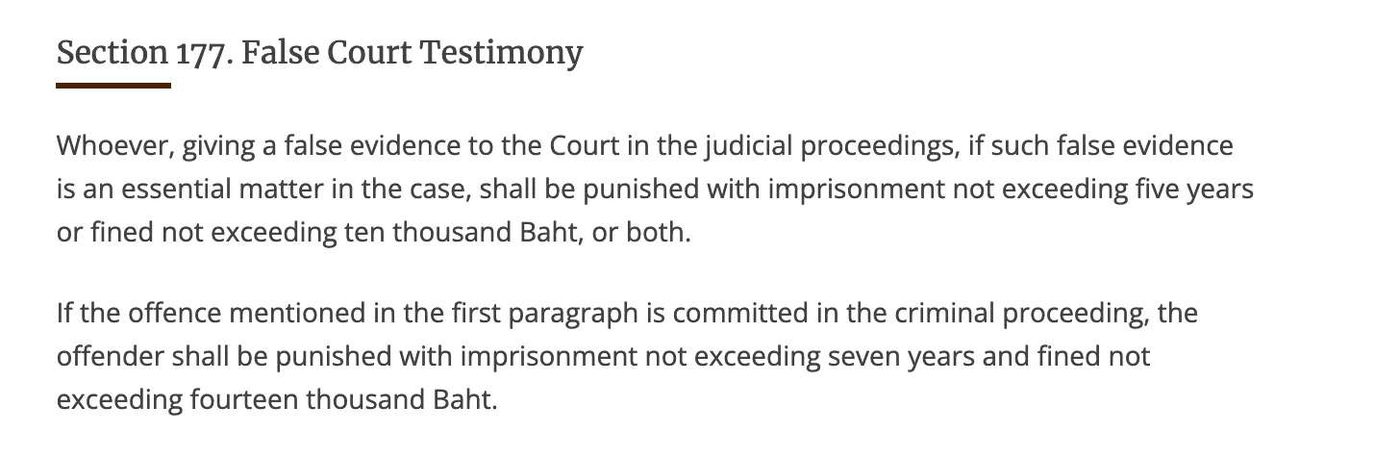
On March 2nd, 2018, I stood before a judge in Bangkok South Criminal Court facing a possible 5 years in prison.
A guard stood behind me holding chains that would be applied to my feet and hands if found guilty.
I had been accused of committing perjury in a labour court case 6 years previously in which I had been the plaintive.
Now, I was the defendant.
This is an outline of the journey that led me to that court and person who made it all happen.
Part 1. Applying to Opus

Lumphini Park, Bangkok (Mark Hathaway, Flickr)
I moved to Thailand in early 2010 to be with my then girlfriend. I had spent 10 years working in Japan but arrived in Bangkok looking for a new life and a new job.
I found, applied to, and interviewed with an executive search company run by an Englishman called Gary Woollacott. He ran a small firm called Opus Recruitment (now calledHorton,a global network it belongs to) and had an office in Bangkok’s CBD.
I had been working in this industry in Tokyo and first applied in September 2009 while visiting the country(1 — attached)stating clearly my reason for wanting to move there.
There were no opportunities at that time however we decided to keep in touch.
Gary used to work for KPMG, a well-known international consulting firm, and promoted his firm as having been “spun out of” KPMG. Though English, he was also the ex-President of the Australian Chambers of Commerce.

Gary Woollacott (Horton International)
We interviewed again in February 2010. The result seemed good with interest on both sides.
Before giving me a job, though, he wanted me to do a few things.
First, he wanted me to go to a networking event with him and another Opus employee. I did that, he introduced me to many people as a potential incoming employee, and generally it went well. Then, he arranged a lunch with the other members of the team. He said if they approved of me, I could join. The lunch seemed to go ok and everyone was nice.
The day after I met them, he called me and said everyone was positive and we should go ahead.
I had a job if I wanted it.
He sent me an email contract(1: see p4/5).He had already told me that because the market was bad, and the global financial crisis was happening, and that he had been “burned” by foreigners in the past, I would at first work on commission “with no basic salary at this stage… until such time as you become a permanent employee and hold a work permit… ”. If I passed probation then he would convert me to a fixed salary, get me a work permit etc. but “for now” I would work as per the basics of the contract: “… If all goes well, the company will apply for a work permit for you in due course and we will enter into a formal employment contract”.
I also had to agree to respect the company’s IP: “… during your employment with Opus or after, except as necessary to carry out the tasks undertaken by Opus on the client’s behalf”.
I was sympathetic to this temporary arrangement and accepted the offer of what I believed to be employment that was subject to probation and, due to this, without yet full benefits (1: p6/7):
Me: “The details of my employment you outlined below — I am happy to go with this for now.”
Gary replied: “All noted”.
He claimed Opus was the best executive search firm in Thailand, seemed sincere, lunch with the other employees had gone well, and I wanted to be with my girlfriend — so I turned down another offer(1c)I had and agreed to join.
It proved to be a very bad decision.
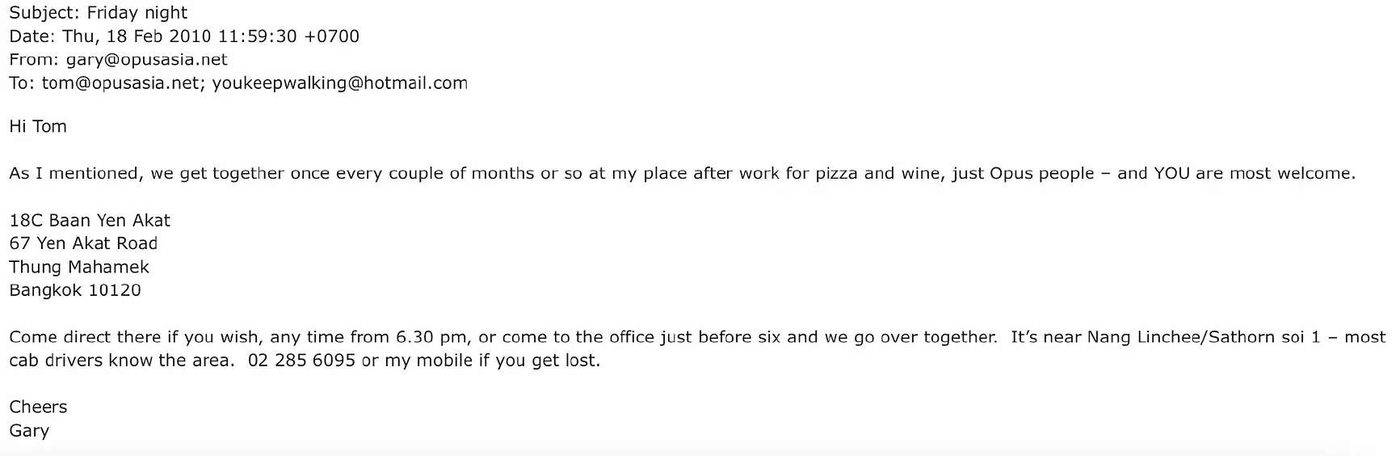
Invitation to a dinner party at his place with other “Opus People” just after I accepted the job.
Part 2. Working at Opus

The Opus Logo as was , now defunct (informational purposes)
The office was small. There were 7 people in total including me and Gary. He also had a small Vietnam office with a few employees.
It was stylish with nice furniture. It had been designed by his ex-boyfriend’s design company. There was a nice view of Lumphini Park. It all looked promising.
However, in the first few months, the reality of working there, and of Gary’s character, revealed itself.
It was very different from what had first been presented.
My colleagues were nice, the office was nice, the problem was Gary.
He was awful.
The person I had met at interview was the marketing Gary, the one he presented to others when he wanted something. The person I saw in Opus was horrendous.
I found him to be rude, arrogant, selfish, dishonest and lazy. His behaviour was not appropriate for work. The employees were miserable.
He spoke to Thai staff like they were his servants, he spoke about ex-employees, people at rival firms, and people involved in Chambers of Commerce badly and had rude nicknames for them.
For example, there was an Australian lady at a rival recruitment firm that he often went to lunch with. Her firm was called “Talent-Plus”. Yet, when he came back to the office after their lunch he talked disparagingly and always childishly referred to her firm as “Talent-Minus”. This sort of two facedness was normal.
Only after joining I found out that most of the other consultants in Bangkok had been there a short time. One of my colleagues told me that Gary had warned them to only say positive things at the lunch because he wanted me to join. I also found out that the last two foreigners who had worked there had walked out because of him. One of them had successfully initiated legal action to get paid and would later become my witness.
These were worrying signs and red flags were starting to be raised.
He was a very emotional person. He always brought his moods and personal issues with him into the office.
For instance, he was gay and had a successful ex-boyfriend named Brenton who had a business in the next building. Gary clearly was not over him. Almost every day we witnessed the bizarre spectacle of him spying on Brenton from the office window using binoculars. He pretended to everyone to be looking at a swimming pool in a hotel beside Brenton’s office. It was unhinged behaviour.
If you had not worked closely with Gary then you would not know his character. Outside the office he could present himself effectively. However, it was all show.
He could not even take a taxi without speaking at the taxi driver like he were sub-human.
I think some people in Bangkok would be shocked at the reality.
Anyone, though, can get some idea of the “real” Gary from a UK TV documentary he appeared in in 2014 called (2)Brits in Bangkok(aka Bangkok Brits).

This was a 3-part snapshot of UK nationals living in Thailand and, even though he now considered himself Australian, Gary took part.
Throughout his segments of the program, he spent most of his time talking about how important he was.
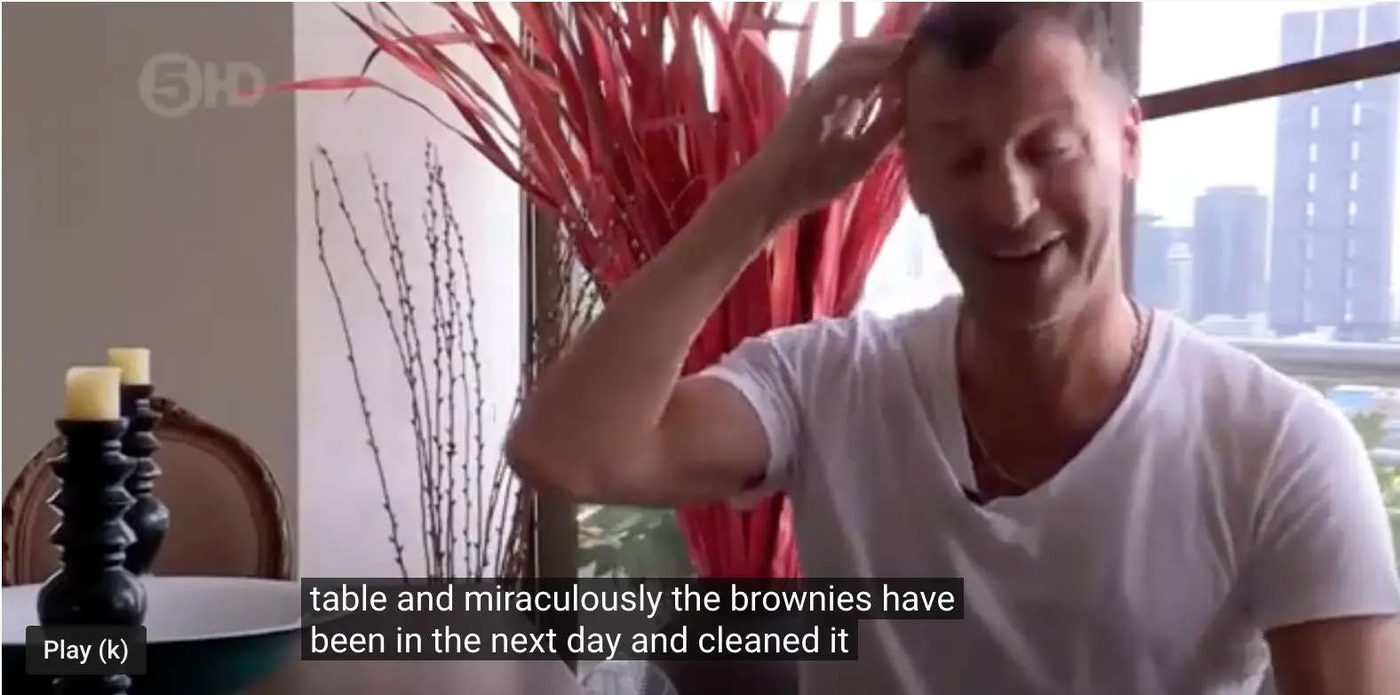
For example, at one point he wondered aloud to the interviewer why a person like him should ever have to do housework when he could throw his stuff on the floor and the Thai domestic staff, who he referred to as “brownies”, could just pick it up?
Part of the first two episodes entails his search for a “live- in” maid. After condescending to the “successful” candidate about the high standards he expected, he directed her to her live-in accommodation…a filthy storage room in the car park(episode two).

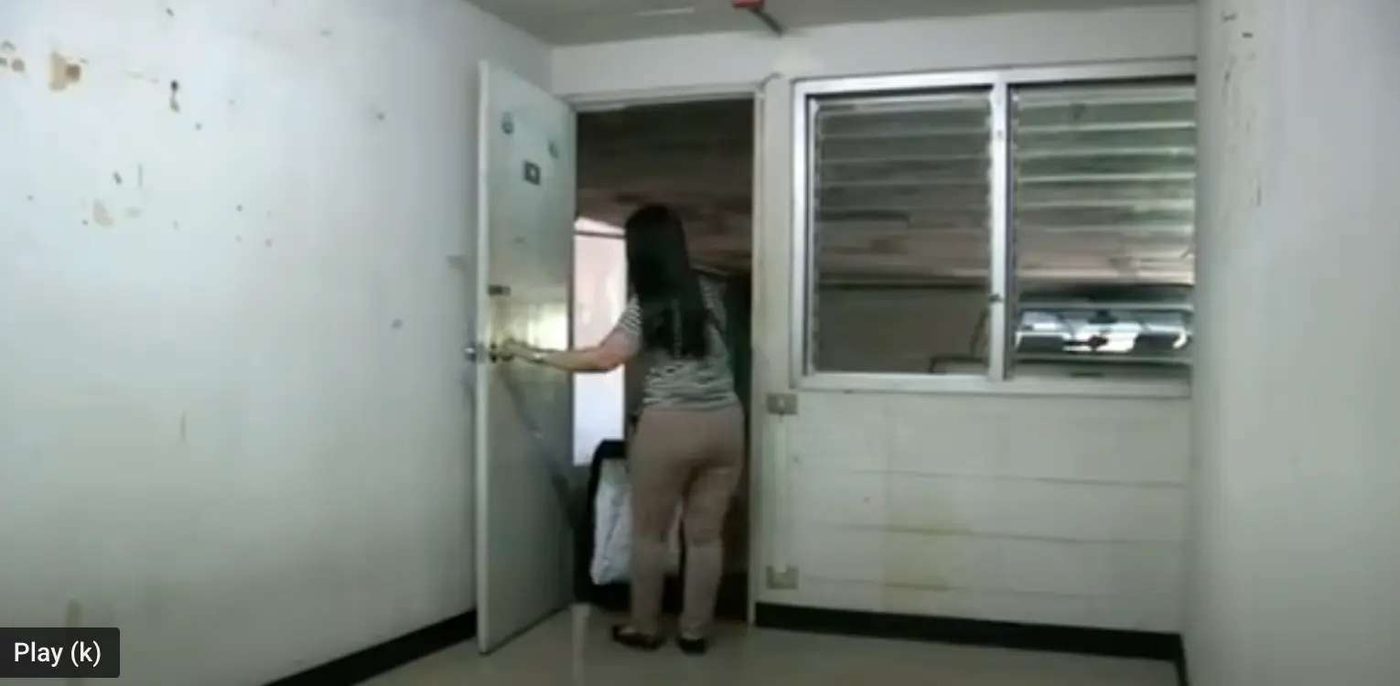
This, and other examples, were representative of my experience of him — demeaning others, self- aggrandizing, tone deaf, and with an overwhelmingly need for others to perceive him as successful and important.
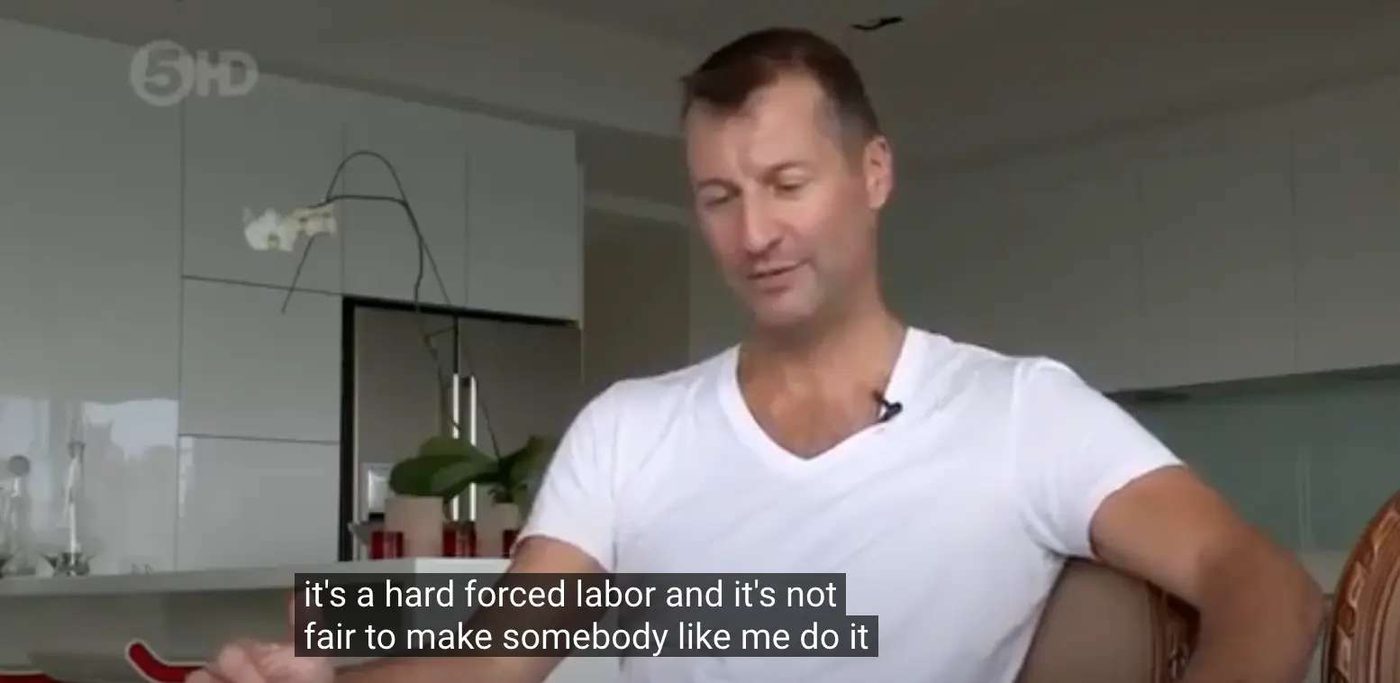
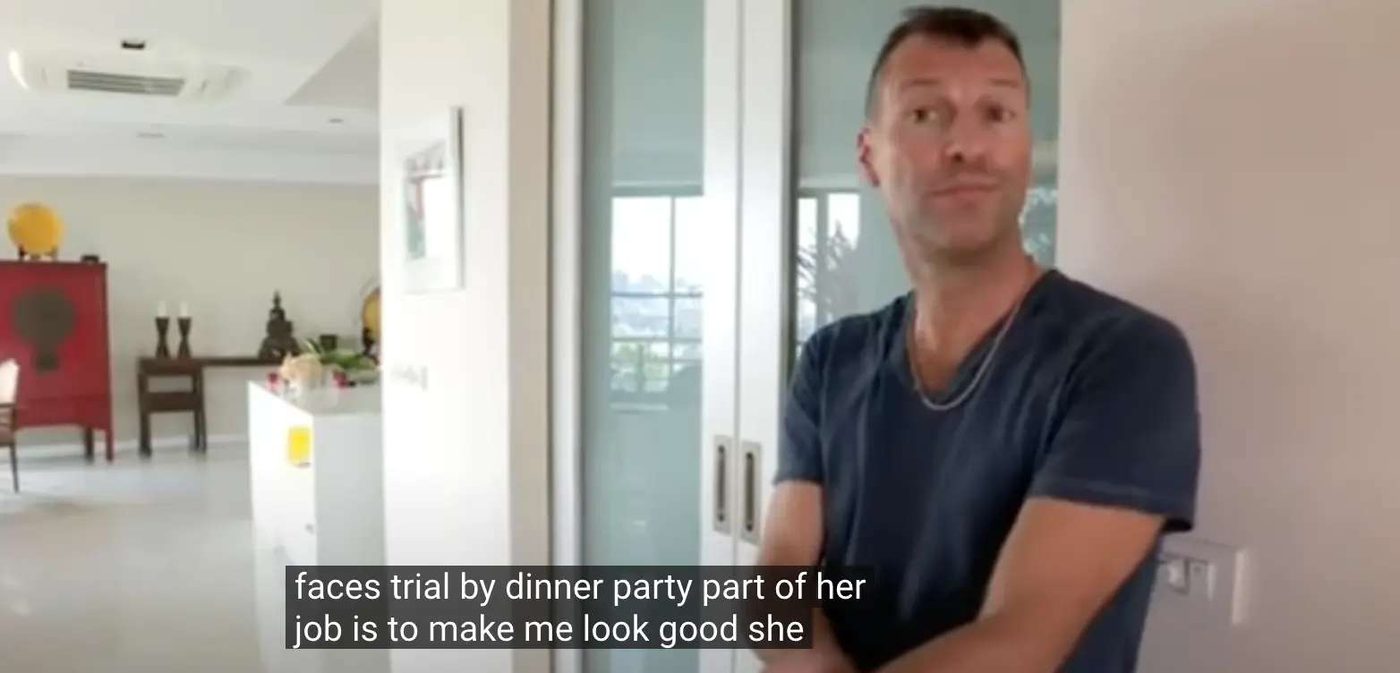
I continued working at Opus in good faith, but it was becoming increasingly difficult.
There were many office rules — processes we had to follow which he was extremely fussy about. He loved to micromanage and would explode in anger if his orders were not followed exactly as he preferred.
For example, we had to enter all our client meetings on his outlook calendar, but he would lash out in fury if the punctuation did not match the exact format he preferred.
Similarly, we had to follow an “Assignment Checklist” for each project.
In itself this was a good idea and common practice; but it also facilitated tantrums from Gary if he sensed anything was not exactly “just so” as he wanted it done, which was usually something subjective, petty , facile or irrelevant.
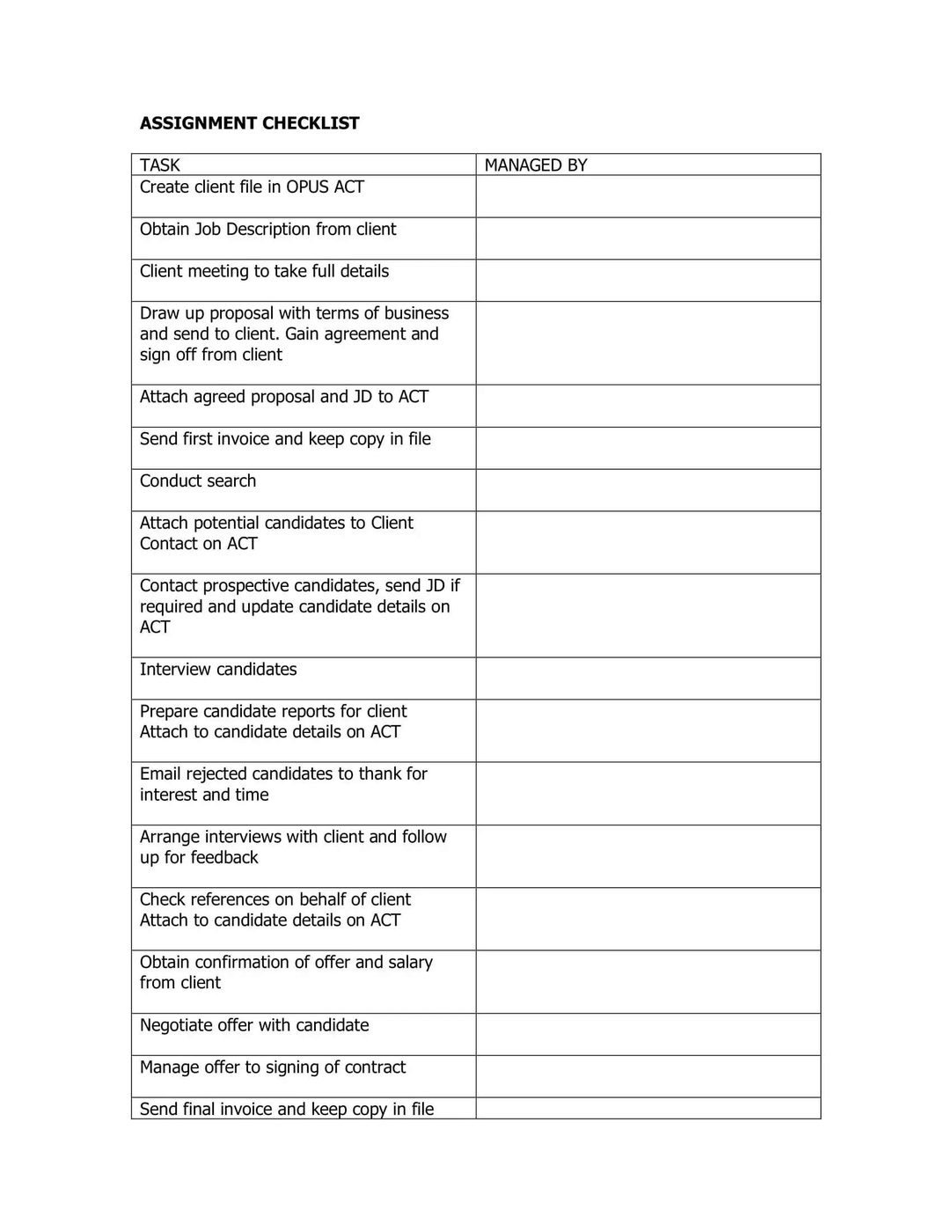
Documents shared already matter of public record in Thai courts (Case 624/2554)
The office manager, Wanna, was regularly in tears because she did not understand his orders. Her English ability was not so fluent. Yet, instead of calmly explaining to her he would simply shout at and berate her. She frequently emailed me for help to translate after Gary had barked an order at her that she could not follow
In my opinion, one contributing problem was that he was in fact very weak at transferring knowledge and a poor communicator.
Problematically though, he believed himself to be outstanding at everything.
The office walls were covered with photographs of himself. He kept a scrapbook from every time he had appeared in articles in Chambers of Commerce magazines. He still seemed to think he was in charge of the Australian Chamber of Commerce because he had been President there years before and hated the current President. Although he graduated from a polytechnic, he pretended to others he graduated from a university.
There was lots of affectation.
And it was extremely difficult to know what he wanted and discuss issues with him as he was moody, insensitive and seemed entirely without self-awareness or authenticity.
And others suffered because of it.
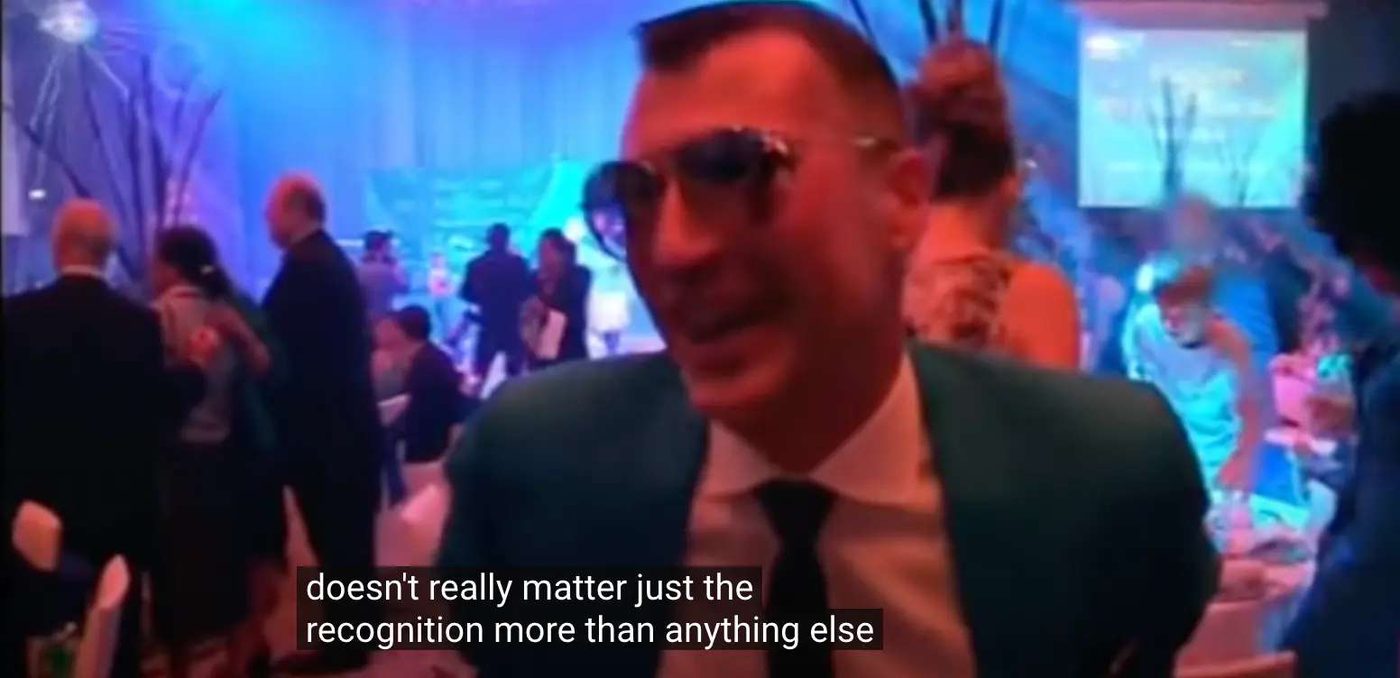
As he was the owner of the firm there was nobody with any authority to challenge his behaviour.
I recall a time he had had a meeting with the Head of HR for the energy firm GDF Suez. They did not have any recruitment needs but needed someone to teach their executives English. Gary had told them he was ideally qualified but that he “normally” charged 20,000 baht an hour for his work. I sat opposite him in the office as he loudly told me this while blithely googling how to teach English to executives. I was quietly horrified at his money grubbing. His lack of ability to do what he claimed did not prevent him offering his services at the same hourly rate a Partner at a top end legal firm would charge.
He was repeatedly dishonest.
He lied to clients, did not pay taxes, claimed work was done offshore when it wasn’t, claimed his holiday and entertainment as business expenses etc.
At one point, for example, he sent emails to the company BP pretending to be a consultant who had already quit. That consultant had done some good work for BP and they wanted him to do some more. His email address for Opus was still active though so Gary simply replied to their enquiry while pretending to be this employee.
(The ex-employee, Narathip, who had left months before, was then persuaded to complete the BP role as a freelancer. He would also go on to be my witness in court).
In the first few months I worked there he must have gone on about half a dozen foreign holidays. One weekend he went to Sydney for a party, just for the weekend. He was obsessed with having an expensive lifestyle and to be seen as successful.
My lawyers checked his balance sheets. Opus regularly made about 15 million baht a year but also regularly claimed about 10 to 11 million baht of that as “other expenses”(3). Isaw his business expenses claim once via Wanna and, for just that month alone, there was hundreds of thousands of baht for holidays, dinners with friends, and gifts, all presented as business expenses.
Consequently, he paid little corporation or personal income tax. Curiously, my lawyers were also to find that he had another company that did no business (BMGW Co, Ltd) but had an active balance sheet.
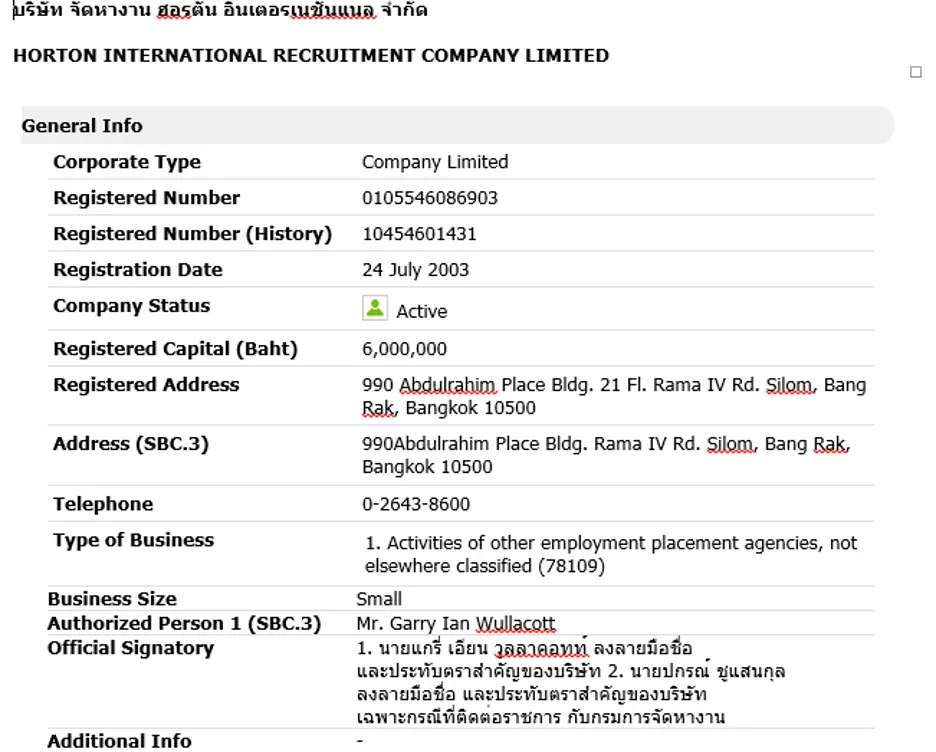
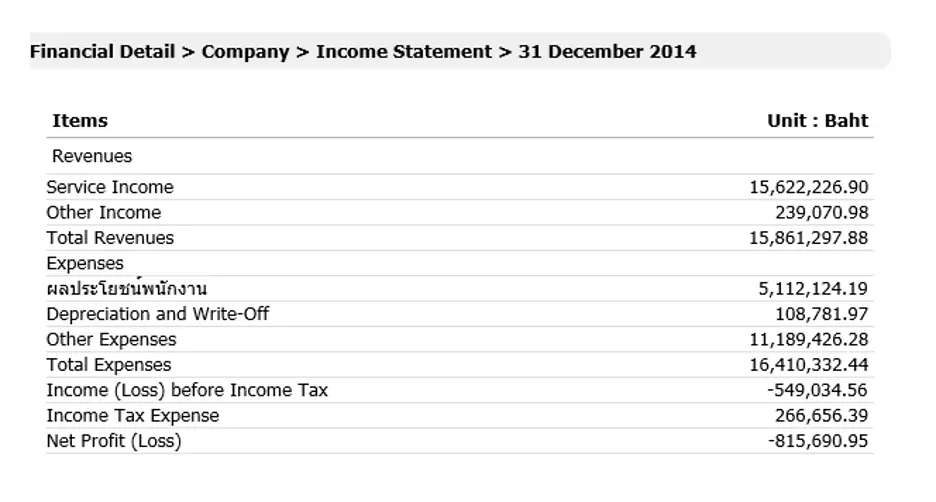
An Example of an Opus/Horton Financial Statement used in Court Case 624/2554.
It progressively became clearer and clearer to me that Gary was not a good or trustworthy person. All except one of my original colleagues (Wanna) quit over the next few months. They told me his angry moods and bullying were too much for them.
One colleague, a researcher, told me that on Sunday evenings he would find himself getting nervous and depressed at the idea of going into the office the next day and could not sleep. When Gary was out of the office the mood was clearly much happier than when he returned.
One time, Gary threw the Bangkok Post newspaper at the office researcher and told him he had 60 seconds to find the price of gold in Thailand for that day and convert it into USD. He counted down from 60 out loud while standing over him. My colleague, in a panic, could not do it and Gary was furious. And it was pointless. It had nothing to do with the work of the office and was just another example of power harassment and cruelty.
Yet, Gary told me he felt like throwing the researcher out the window for not being able to do it.
Over the months it had also become progressively apparent that he did not intend to give me a regular salary and work permit as promised. My colleagues told me I should ask again, and I did, but he just avoided the subject.
I had joined the company “fresh off the boat” from Japan.
Although I passed the 4 months’ probation, by that point I had learned that there was a Thai v. foreigner ratio work permit rule. I had also invested 4 months in projects where I would only be paid my full commissions at the end of the delivery. However, as so many Thai employees were quitting, the promised work permit seemed to be miles away.
One solution was that he had a small Vietnam office.
In August 2010, he asked me to go over to Ho Chi Minh City to try to BD a few clients, renew my tourist visa, interview a candidate for a Thailand CEO role, and also to meet the Opus Vietnam team (2.5 people) to see if I would like to manage that office. He said many positive things about Vietnam and the business there.
This was the first time I met Yen, a nice middle-aged lady who worked for him there. She had been told by him to reserve a hotel room for me and I also went with her on a BD meeting to Panalpina logistics who I had done work for in Thailand. She would later submit testimony to the court about this.
Gary went with me on the Vietnam visit. He showed me round Ho Chi Min City and wanted to impress me with it.
And the employees all smiled in front of him.
However, it was not a surprise when the three local employees told me another story about him when he was out of the room. I found out that that they, like the Thai employees, did not like him. They said that the company operated illegally. It was a rep office and was not supposed to provide recruitment services.
I felt like I was being set up.
When I returned to Bangkok, I told him I was not going to relocate to Vietnam but instead was going to finish up my work and then leave Opus.
He reacted with typical hostility.
I could not quit straight away because I was working on commission and needed to complete the projects I had started to see any payoff for all my hard work. My life situation made it very tough to just walk away and let Gary collect all the return. Due to the nature of the work, I had had many months with no income at all. However, I had been working very hard, had closed three major roles, and was due a big payoff at the end of November.
Meanwhile, unknown to me, Gary was trying hard to make sure this payoff would not happen.
In early November 2010, an employee called Malinee, who had only worked at Opus two or three months, and who I knew was unhappy, informed Gary she was leaving because she was unhappy working with him. I sent her an email telling her if she was not happy then she was doing the right thing and wishing her good luck. She left.
On Monday November 22nd 2010, I got a call in the early morning from the office manager, Wanna, telling me not to come in till the afternoon because there was a “computer problem”.
Pattaraporn, the only other employee left in the office, was absent that day. I was immediately suspicious. I was due a payment of 714K THB at the end of that month — the result of those many months of hard work that I had done for 3 companies. After that I would have been done with Opus.
When I went into the office, after lunch, Gary was there with Wanna.
He had been looking at Malinee’s mails and had a paper copy of the “good luck email” I had sent her in his hand. Waving it in the air, he said he was not happy about it and told me to return my office key and my pass and to get out of the office.
I refused to leave until he paid me. He then asked Wanna to call security.
I left the office.
Opus/Horton Business Card
Part 3. Gary Accuses Me of Theft & I Go to Labour Court
He sent me a rude and aggressive email(4)about a week later.
In it, he said he had since gone through my mails and he then accused me of (a) stealing intellectual property and (b) sending rude emails to my colleagues about him and the company.
I did neither of these things. If that had been true, he should simply have reported me to the police.
Instead, I believe he had decided he did not want to pay me what I was due, had seized on the “good luck” mail to Malinee as an opportunity, and had been searching for a reason to justify not paying me my wages during that week. I also believe, at that time, he was searching for a story to justify dismissing me “for cause” to avoid possible severance pay issues.
By the time of the labour court case (in Part 6 below) his portrayal of events would have changed completely but, for now, his narrative was to blame me for something he had simply made up.
And he said if I wanted to negotiate I should do so.
This strategy would not be a one off. As we will see, the “come and negotiate because you are to blame, not me” tactic would be repeated with Yen from the Vietnam office about 8 months later. I would find out he had done something similar with another employee before.
I was very, very upset.
Here was someone who had misled me into believing that his office was the right choice, who I had trusted in good faith, and for whom I had turned down another offer.
He had promised me a work permit and regular salary. I was trying to build a new life in Bangkok but had had to work in extremely oppressive work conditions observing his bullying, his moods, his cheating of clients and his aggressive, controlling and unhelpful attitude.
And now this?
Everyone else did the work; he kept the money.
I had brought in about 3.5 million baht in revenue that month and my share was 714K which was just 20% of the total. I had already informed him after coming back from Vietnam that I did not want to continue with his firm and with the current situation. Wanna would later tell me that the week before he dismissed me he had asked her if I had booked a flight back to the UK yet. I presume this is because he wanted to maximize leverage and knew legal action takes years and costs a lot of money.
I sent an email demanding my money be paid at the end of the month as per contract and past pattern, but he did not pay. I then went to a law firm who sent a letter of demand which he just ignored.
Around that time, the Opus researcher, Pattaraporn , called me to say that Gary had asked her to claim that she had done my work(5).She refused but it seemed clear to me from Pattaraporn and Wanna’s comments he was exploring dishonest ways not to pay me.
We also chatted on Facebook messenger afterwards.
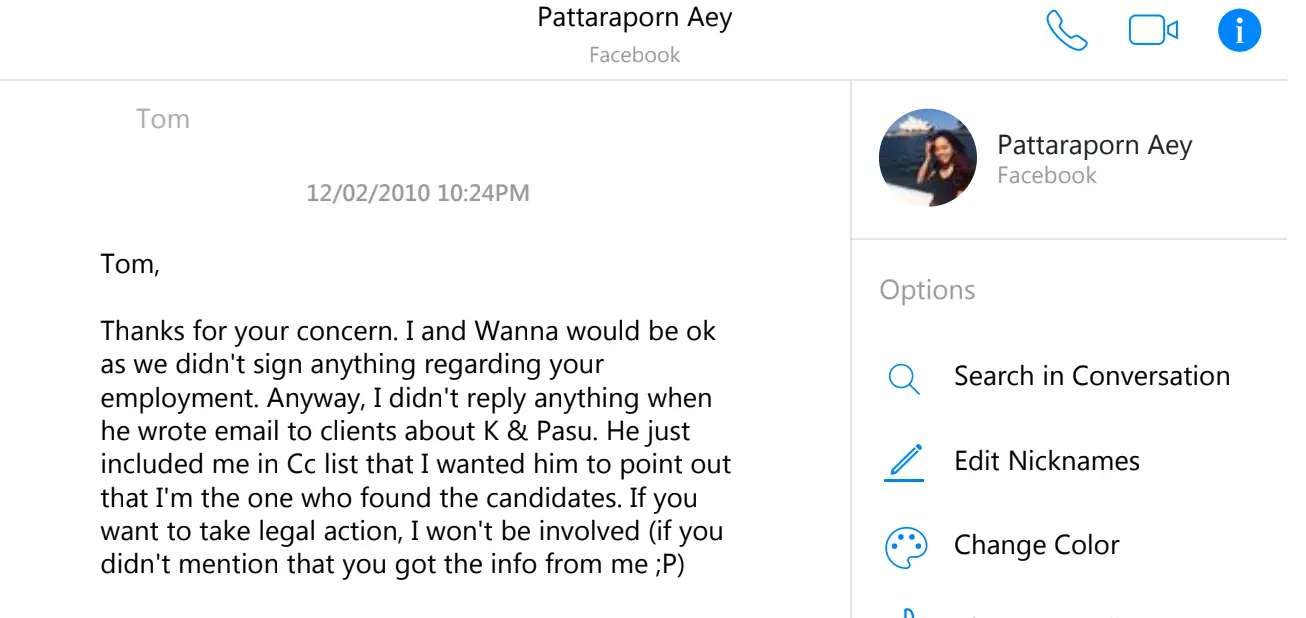
From messenger exchanges with Pattraporn on Facebook about a week after I was dismissed
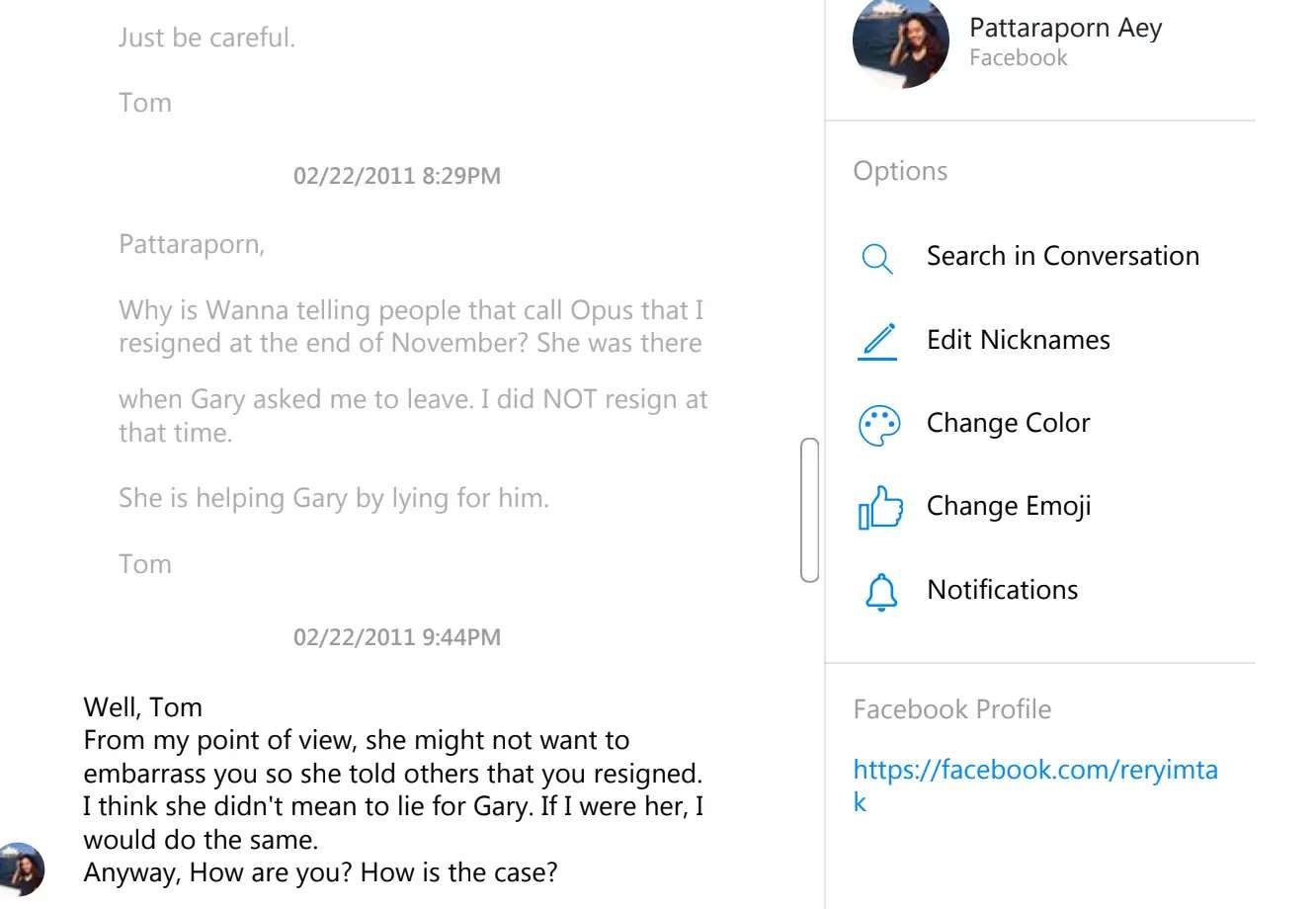
A few months later he had instructed Wanna to tell people I had resigned.
Also worth noting is at this time he was asking banks for a 4-million-baht loan to redecorate his home but had been repeatedly refused. Some months later I was informed that he was boasting about his newly redecorated apartment at networking events.
I had given him every chance to pay but he did not. Consequently, I decided to go the labour court for advice. Never having used a lawyer before I did not know what to do. I hired a translator and went to Bangkok’s central labour court in February 2011 and spoke to a lawyer there. He listened to my story and told me I should file a complaint. He actually wrote the complaint for me through the translator. A week or two later Wanna nervously called me on Gary’s behalf. They had received the complaint and were prepared to offer me…. 200K THB. I put the phone down at the insult.
Around this time, I had written emails to the clients I was still owed money for. They were all sympathetic and said they would urge Gary to pay me. Kevin Corning, a GM at a firm called DKSH, did so and forwarded Gary’s response to him on to me(6).It was full of dishonesty.
There were at least three lies in his mail:
1. He said that I was always paid after the candidate passed probation. This had never happened. I was always paid at the end of the month/or beginning of next month as per contract (1) attached: “Commission will be paid as soon as possible at the beginning of each month once the receipt figures for the previous month have been finalized”. I also had bank statements to prove it had always been the case.
2. He said I had slandered him to the rest of the office which I had not.
3. Again, he said I had stolen IP which I had not.
However, this email also used the word “freelancer”. This was the first time I had heard it and I was alarmed. My contract used the word “employment” (“during your employment with Opus…”), I accepted his offer in an email chain that only talked about “employment”, and he had said nothing to contradict this impression verbally or in print:
• My reply to his offer — “The details of my employment you outlined below — I am happy to go with this for now. I realize you are giving me a chance. However, as a comparison, I had an offer from Monroe Consulting which was…(XYZ)….Nevertheless, let’s see how things go for now”
• His reply to me — “All noted. I am always available to discuss compensation with anyone who performs. But, as you know, I’ve been burned three times which has led to my reticence on that front. I certainly don’t see that happening this time. “
He made no effort to correct me when I accepted the “details of my employment”? He would later say in court it was clear from the start and openly discussed that I would be a freelancer so why did he not make clear that I was a freelancer here if that was what I was really supposed to be?
Why did he even mention work permit, probation, fixed salary or employment if I was indeed meant to be a freelancer? Why did he use the phrase “until such time as you become a permanent employee”? If I was a freelancer he should say ‘until such time as you become an employee’.
Why did I believe I was an employee? So many reasons. I had to behave as an employee at work, he had made every effort to make me believe I was an employee at interview, in my contract and after I joined. I accepted the job and worked there on that basis. I knew I needed an employer to get a work permit, I believed it was on its way with Opus due to Gary’s words. It is in fact impossible to legally be a foreign freelancer in Thailand.
Moreover, I had to follow all the work rules and procedures the same as everyone else in the office. This is a key difference in law between work for hire and work for service.
For example, I had to be there every day at consistent hours; report everything I did to him; load all CVs I generated into his database; get his approval for every new project; Cc him into emails, enter appointments into his calendar; follow an Opus checklist for all the work I did; take my turn looking after the office one lunch time a week; go to business development meetings with one other consultant as per office rules; go to networking and other events as per office rules; go to company social events; had my name on the company profile given to potential clients; had Opus business cards; had business expenses paid for me; was introduced to clients and potential clients as an employee by Gary; etc.
This is not what a freelancer does.
He had even projected a career path for me if the contract mail and the interview.
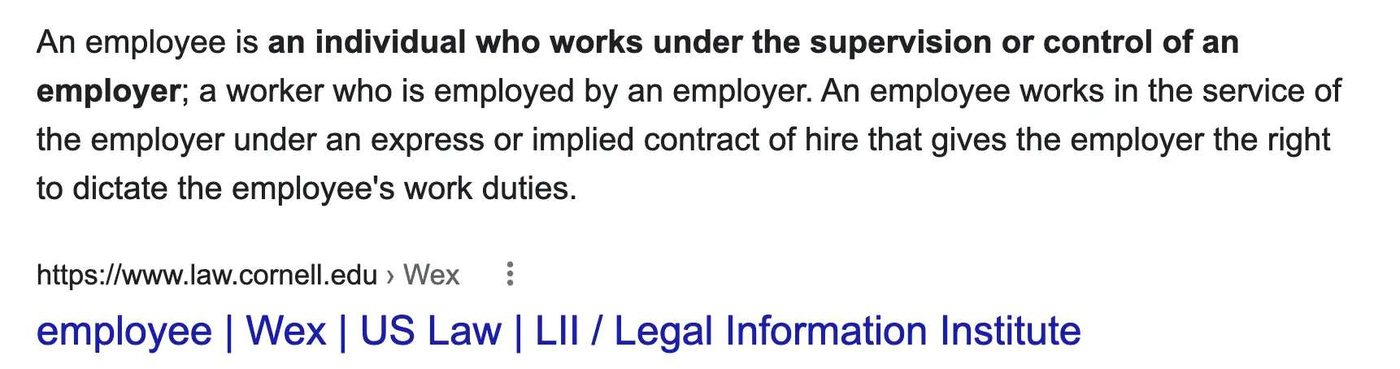
Under US law but similar in Thailand.
And I had witnesses to confirm these things and who testified for me at court.
At no time, not once, verbally, or in print, was I referred to as a freelancer by Gary or treated as one. It was only after receiving the DKSH email I started to research what that could mean and what his angle was. He had changed the story when it was to his monetary advantage.
When I went to the labour court, I was told I should get a lawyer to help argue my case.
I had used a firm previously to issue a letter of demand only. I contacted a firm called Juslaws and discussed the above with them. They told me it was a clear labour court case(7).Gary’s lawyer filed an objection to it being a labour case but the court dismissed the objection and decided to accept the case(8)and so I believed this was not an issue.
Not long after, in May 2011, I got a new job and joined KPMG Thailand which ironically is the firm Gary used to work for (but who I later found out had decided to let him go).
At interview, I had told the COO , John, who hired me, openly about the situation and that I was suing Gary. Not long after that, Gary contacted the John with the same story about me stealing IP and telling him that he should fire me. John did not believe him and instead informed me of what Gary had said. Gary would later call the CFO, and contact an audit Partner, to again try and get me fired. None of it worked.
I believed he wanted me out of the country so that I could not pursue the labour court claim.
A week before he was due in labour court for the trial (March 2012) he again came to KPMG to see the COO and told him I had to drop the case, or he would file criminal charges. John told me this the same day, just after meeting him. I told John if that was really the case then Gary should tell the police. He agreed and also told me he got the impression Gary would try to “buy the judge”.
Gary had made sure never to do any of this harassment by email. I think he knew what he was doing constituted criminal defamation and did not want a trail of documentary evidence.
I had been told by a few people that Gary had repeatedly trashed my name to others at business networking events telling them he had recently gotten rid of some “deadwood”.
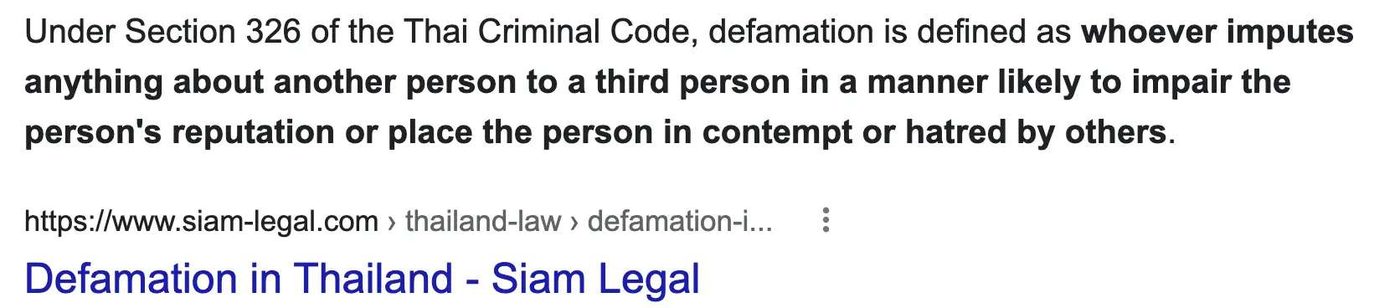
The day before the trial he called the boss of one of my witnesses (who was by then working at a recruitment company called Enworld) to try and get her to pressure him into not testifying. She refused to do so but told my witness about it.
This was clear witness intimidation. However, to escalate this, as well as his defamation of me to KPMG, would have meant involving many bystanders in a criminal charge, which I was reluctant to do. My lawyers also told me to focus on the current case.
Part 4. Gary & Yen : A Similar Story of Blame and Negotiation
The trial would not happen till March 2012, more than a year after I filed the complaint. However, two other significant things happened before then that were both connected to Yen, the lady I had met in the Opus office in Vietnam.
Yen was easily his longest serving employee. She contacted me about 3 months after I started KPMG, in July 2011. She told me she was in trouble because of Gary. It turned out that after I had refused the role in Vietnam, he found an American man called Steven to run that office. Yen said Steven was very aggressive and was unkind to her. When she complained to Gary about him, he told her if she did not like it she should “find a new job”. She said that she knew then he wanted her out of the firm.
She continued to work there but one evening, as she was going home, Gary called her and asked her not to come into the office the rest of that week because they were “redecorating”. He said that he would contact her the next Monday and update her. He did not call on the Monday so she then went to the office the following Tuesday morning. On entering, she found the American manager’s girlfriend was now suddenly sitting at her desk. They shouted at Yen and told her to get out.
Upset, she contacted me to ask for advice because she knew of my similar situation. Yen was in her 50s and a nice, harmless lady. I told her to go to the labour court to get help and not to be bullied. She did this and also got help from an organisation that takes care of foreign businesses in Vietnam (Fosco). They told her not to try and work there anymore and that under Vietnamese law she was still entitled to be paid severance for years worked and Gary had to pay within a limited time (maybe 14 days, I cannot recall).
Fosco sent Gary an email reminding him of the law.
This initiated the type of response from Gary to Yen that I was only too familiar with.
His strategy would be to 1. blame her, the victim, and 2. invite her to negotiate/settle for less than she was due(9)
Just as he had done with me, his cruel behavior to her was completely overlooked. He had cheated Yen out of a job and was not paying her severance yet trying to blame her and, once again, make it look like he was the injured party, the victim.
He sent her a mail(9 : 31.8.11)in which he tried to justify not paying her the total amount she was due by claiming he had just discovered he had not paid enough personal income tax in Vietnam and so was blaming her for that.
He said she should have told him and so he (or “we” as he often referred to himself) would not pay her the full severance due:
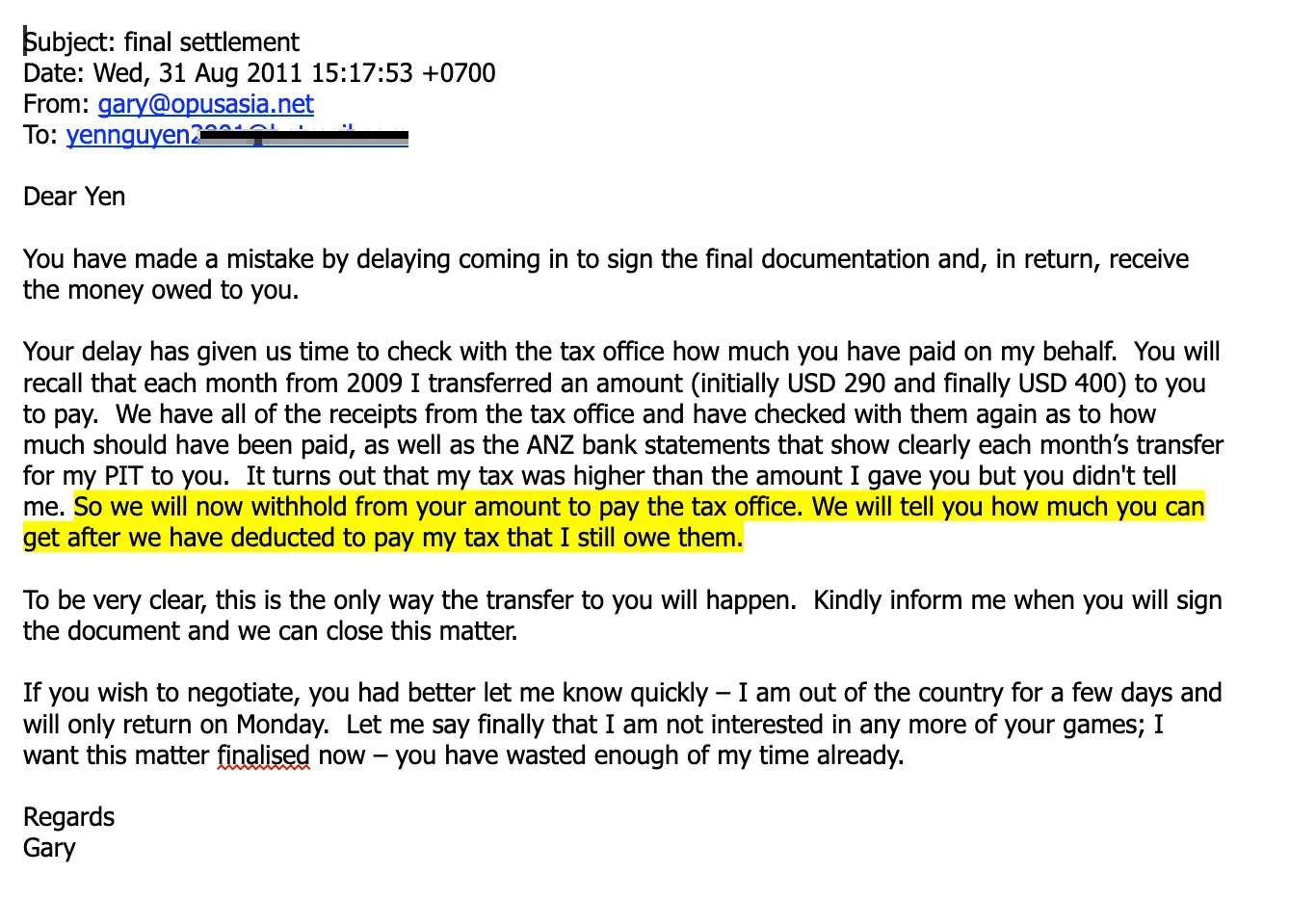
Yen was a recruitment consultant. She was not his accountant, or PA, or lawyer. Gary’s Vietnam income tax was not her responsibility. She merely paid what he gave her on his behalf as a kindness. She did this honestly and in full. Moreover, this had no connection to her severance pay and she was not “wasting his time’ as he suggested. Yen reminded Gary that it was his responsibility to pay his personal taxes in full and that to try and blame her for him not paying his own income tax was “stupid”.
Gary replied dismissively(9:14.9 11).Still trying to blame her and avoid responsibility he again told her he would deduct the income tax he owed the Vietnamese revenue department from the amount he owed Yen. He again attached a document(10)which he instructed Yen to sign. This document dishonestly claimed she had been paid in full. He finished his mail with “that is the end of the matter”.
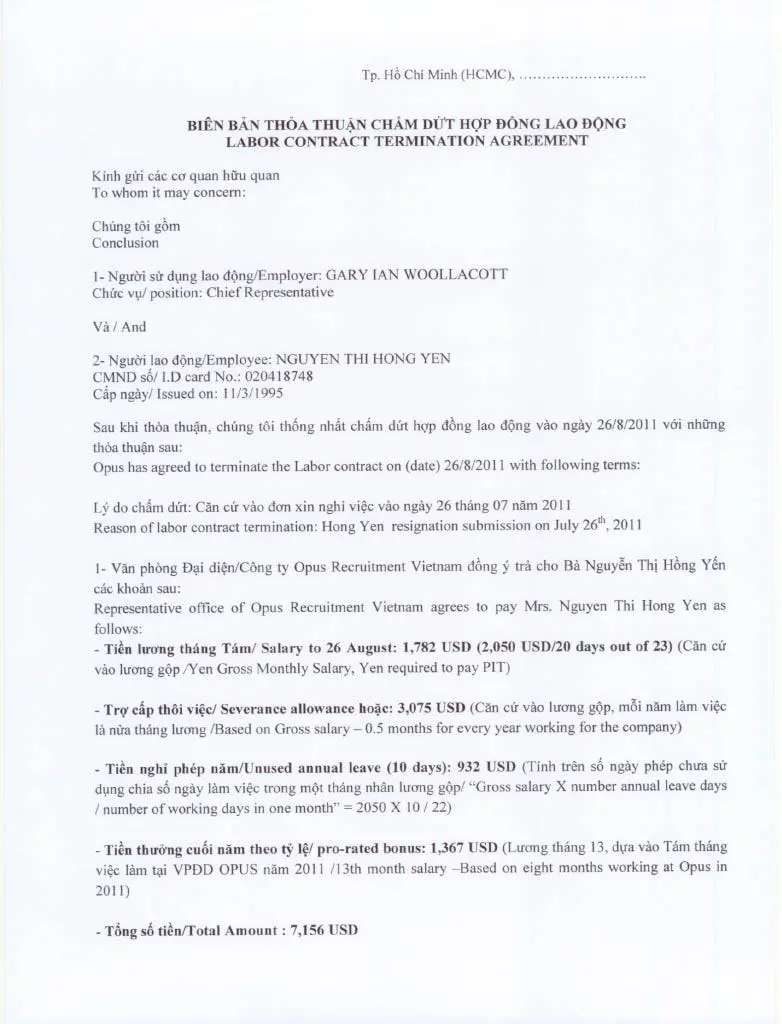
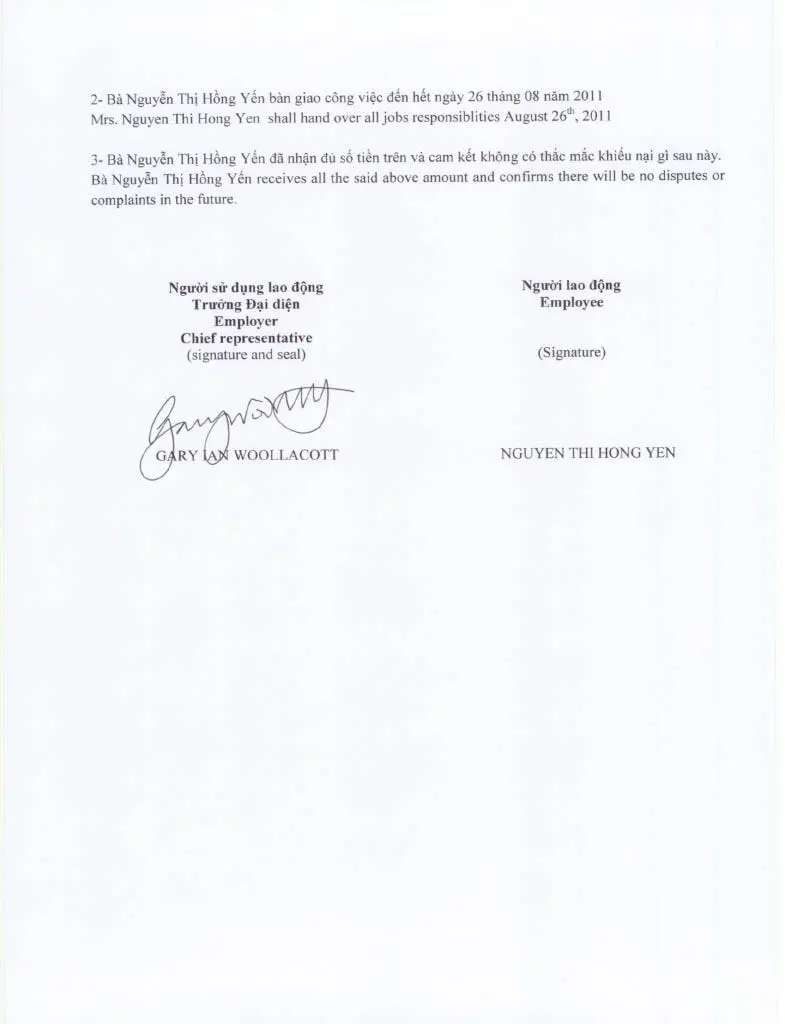
Yen again refused to sign it.
And, 5 months later, on the first day that Gary was due to appear at labour court in Vietnam, he sent a message to the court to say that he would, after all, pay in full(9:17.2.12):
From:yennguyenXXXX@hotmail.comTo:tmccrum@kpmg.co.th;youkeepwalking@hotmail.comSubject: Update Date: Fri, 17 Feb 2012 15:15:23 +0700
Hi Tom
How are you? I want to update my situation to you.
Yesterday, I went to the tribunal at 2:00 pm as the judge requested to meet the representative of Opus but when I come there the judge told me that they refused to come and said that they will pay the whole amount that they still owe me next week. The judge told me that next week he will inform when I can come to receive the money with the person of Opus in front of him and sign on the confirmation letter that Gary signed before.
Finally, my complaint letter that submitted to the tribunal has been solved after 3 months. I told this good news to my mother and she is very happy and cried. I myself cannot believe that just a phone call from the judge to ask them to the tribunal then both Gary and Steven quickly arrange to pay to me.
Tom, how about your case? Did your case already go on trial? Did the judge already call Gary to the tribunal?
Hope to hear the good news from you.
Yen
So, he paid up. However, he only did this after being held accountable by a court, 8 months late, after lying to Yen, rudely ejecting her from her job, threatening her, and trying to reframe events to blame her for his own cruel actions. He put a faithful employee and harmless middle-aged lady through a horrible ordeal using the familiar strategy of victim blaming and attempted exploitation. All so he could try to avoid paying her 7000 USD severance.
Note that my lawyers did not mention this similar case in court because, oddly, they said a Thai court would not see the relevance. However, Yen did give a statement about her working with me at Opus (see 15 below).
Note: Two weeks before the trial I also noticed on linkedin Gary was employing a young English woman calledSamantha Willeywho was the daughter of a lady who worked at his ex-partner’s firm,DWP.(10b)I checked her facebook page in which she talked about how she was getting 20K THB a month and
p g g g needing to go on visa runs. I sent her an email asking if she had a work permit. She did not reply but immediately changed her linkedin profile to say she was working for Opus in Vietnam (she was not).
Part 5. Repeating His Story in Print — the “Employee” that he “Fired on the Spot”

The header for his hilariously titled column in AsiaLIFE magazine (now discontinued)
The second significant development that came via Yen concerned me directly. In later 2011 she told me about some articles Gary had written in a magazine in Vietnam earlier that year.
He had written three separate articles(11)for a monthly magazine called AsiaLIFE all referring to the same “employee”.
He does not name me in the articles, but Yen said, and testified, that he talked openly about them in the Vietnam office. In the articles he tells the same story he told to Kevin at DKSH(4);the same story as in his nasty email to me(6);and the same story he told to KPMGs COO, John.
He had told me to get out of the office on Monday November 22nd 2010. The first article is from the December 2010 issue and begins:
“…a couple of days before writing the column”, he “fired on the spot” an “employee” for what “he” had been doing which was “trashing his employer” by sending mails to another “colleague” using the “hardware and software that you use every day”.
Note three things.
1. I wrote one email to a lady called Malinee supporting her decision to leave and wishing her well. I never trashed anyone nor the business to my colleagues. I did write some emails to myself reminding me that I should leave that firm due to Gary’s behaviour but only I saw them. He provided no evidence to me except this one email; and provided nothing to the court.
2. When questioned about these articles at labour court he told the judge they were “not about anyone in particular”. Three separate articles about the same “employee” and “employer” with time markers that exactly matched my story and matched the mails he sent to both me and DKSH. Yen would also give a statement to the court about how he had openly talked about the articles being about me in the Vietnam office.
3. I was also the only “he” left working at Opus in either country at that time.
This is how the second article (January 2011) starts:
“Last month I talked about an ex-colleague who had been discovered behaving inappropriately on company email (and on company time)…”
The third article talks about how I tried to complain to clients about him and get him into trouble with the “authorities” none of which I had done. I had asked clients for testimonies for the labour court which they had gladly given, and I have included here. That is all. He also suggests how my using labour court would not work but he would not go into details:
“We have received a labour court summons, which is surprising given certain aspects (which I won’t go into here — ask me if you are interested).I’ll let you know what happens there”.
I presume this is because he was now deciding to call me a “freelancer” at the labour court. Yet in this same article, from April 2011, he is again calling me an “employee”. He was choosing his words and version of events differently for one audience in Vietnam and a different audience in Thailand.
Part 6. Labour Court & The Story Changes ("he didn’t fire me; I quit").

The Labour Court Trial finally started in March 2012. This was 14 months after he had ordered me to leave the office in November 2010.
Gary’s prepared statement(12)and court testimony during cross examination(13)contained 50 to 60 lies (though some duplicated).
Among them, the story of firing an “employee” in the articles etc. changed to an entirely new one, summarized as follows:
Gary and I, who Gary said knew from the start was a ”freelancer”, got into dispute over how much money I was owed and so I left the office by my own choice.
He added that there were only the two of us in the office and that Wanna was not there.
He also said he delayed payment to me because Opus’s terms and conditions means that Opus had to refund fees to clients if the placed candidate did not pass probation.
What he had accused me of in his rude email; what he told Kevin at DKSH; and the same story he told the COO; what he had written in the articles…this version no longer happened.
His story had completely changed.
Now it was a story consistent with the idea I was a freelancer and not an employee and so this was not a labour court matter, with no severance etc due, but a fee dispute and a civil court matter.
Some of the lies he told are difficult to prove wrong because they were verbal and there is no documentary proof. However, many of them did have documentary proof and almost all the lies were contradicted by my witnesses.
Some things he said had also been carefully chosen, I believe, to hedge his bets in case I won so that he could try to claim I was not entitled to the full amount I was owed but only a partial amount.
And he had no witnesses. Not one.
Although he did try to create one witness and force her to lie for him.
Wanna, the office manager who still worked with him, had told my witness, Chottiwut, that Gary had forced her to sign a statement(See 12b)saying that everything Gary claimed was true and it was submitted to the court.
However, Chottiwut told her this was perjury. and urged her not to do it. This may have had an effect. She was withdrawn from being a witness and did not appear at the trial as Gary had planned. Her prepared statement was also withdrawn but was a verbatim copy of Gary’s statement.
Whether she did this through integrity or whether Gary and his lawyer were not confident she would survive cross-examination I do not know. However, as part of his new narrative, he now wanted to claim that there were no witnesses to my dismissal and that I had, in fact, quit.
Wanna was a witness on the day he fired me, she was the only other person in the office. My guess is that this is why she was no longer a witness. He wanted to hide her from cross-examination.
Chottiwut and Yen’s statements are attached and so is Gary McEwan’s and my own(14b).I worked with Chottiwut and Yen but not with Gary McEwan who I had learned about after leaving Opus.
Gary McEwan was an Australian who I found had worked for Gary Woollacott before me but also had had to take legal action.
• Chottiwut(14 in Thai)confirmed I worked as an employee, had to follow the same rules as another employee, was ordered by Gary, was not free to work with others, that there was no guarantee to refund clients etc. He also confirmed that another person who had started out as an employee but left then became a genuine freelancer (Narathip) and did not have to follow work procedures and come to the office.
• Yen(15)confirmed that in August 2010 Gary asked her to reserve a hotel room for me and one for him for a business trip to HCMC because Gary had asked me to manage the Vietnam office. She confirmed I worked on a project with her (Mayer Brown) as directed by Gary, was always referred to as an Opus employee, and also that Gary had openly talked about the Asia Life articles and what they were about — me.
Gary McEwan(16)described how his contract was similar to mine however was based on a draw system, how our job rules were the same e.g. following the Opus assignment check list(17),how we did not refund clients if candidates did not pass probation, how his work permit was similarly delayed till after probation, and other aspects that mirrored by situation.
AND how Gary did not pay him and became abusive and aggressive when payment was demanded. Also, how Gary Woollacott tried to take credit for his (Gary McEwan’s) work. Gary McEwan had to consult lawyers and eventually Gary Woollacott settled out of court but only after trying to blame Gary McEwan who, in the end, was not paid all he was due but settled for less to avoid stress.
Gary McEwan also mentioned that Gary Woollacott also did something similar to a lady in Vietnam (who I did not know and did not know the details of). However, she did actually contact me in December 2022 because she had been held FOR A MONTH while visiting Vietnam due to an unpaid Opus tax bill that Gary had framed her for.

The Final Paragraph of Gary McEwan’s Testimony
Here also is a sample of some of many client testimonies I got(18).Each one believed, like me, that I was an Opus employee.
For example, here is one from Tom Thompson who was GM of Liberty Mutual Insurance:
“To Whom It May concern,
The Purpose of this leter is to confirm that I was introduced to Tom McCrum as a new employee of Opus recruitment by Gary Woollacott of Opus Recruitment on 10th of March 2010 at a Chamber of Commerce Netwoking evening.
Should you require any further information please do not hesitate to contact me.
Yours faithfully,
Tom Thompson”
This was just weeks after I had joined Opus. He believed I worked for Opus due to Gary’s words and so did I.
Or, this from Robert Reiter at Panalpina Thailand:
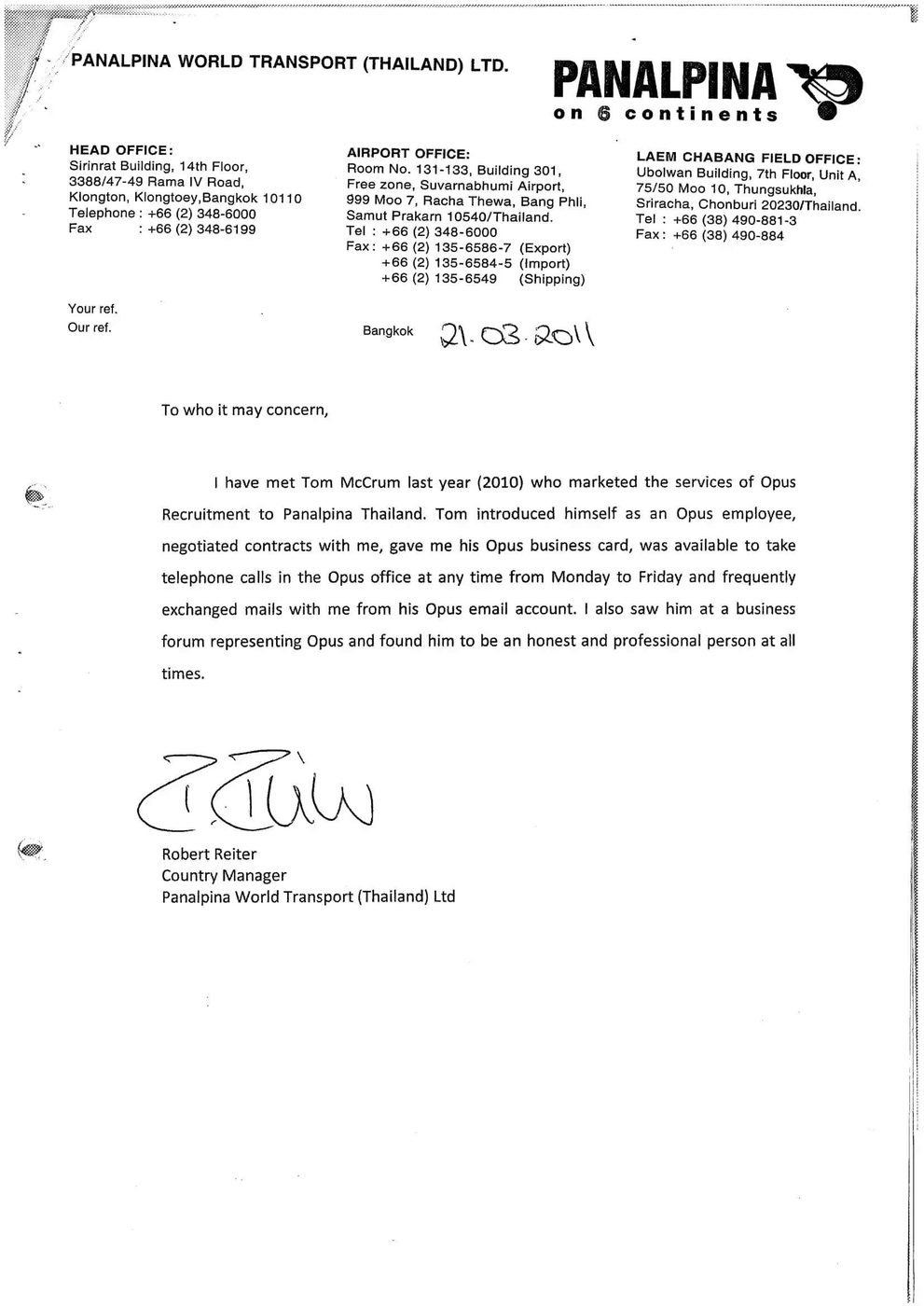
I would have given people like Tom Thompson, Robert Reiter and other potential clients a business card(19)which was the same as my colleagues and an Opus BD/Presentation Pack(20)which outlined the company’s T&C and included the consultant profiles, including mine. Gary would later tell the court I insisted on being included in the presentation pack but was still a freelancer. I did not, it was his decision to include me and only his.
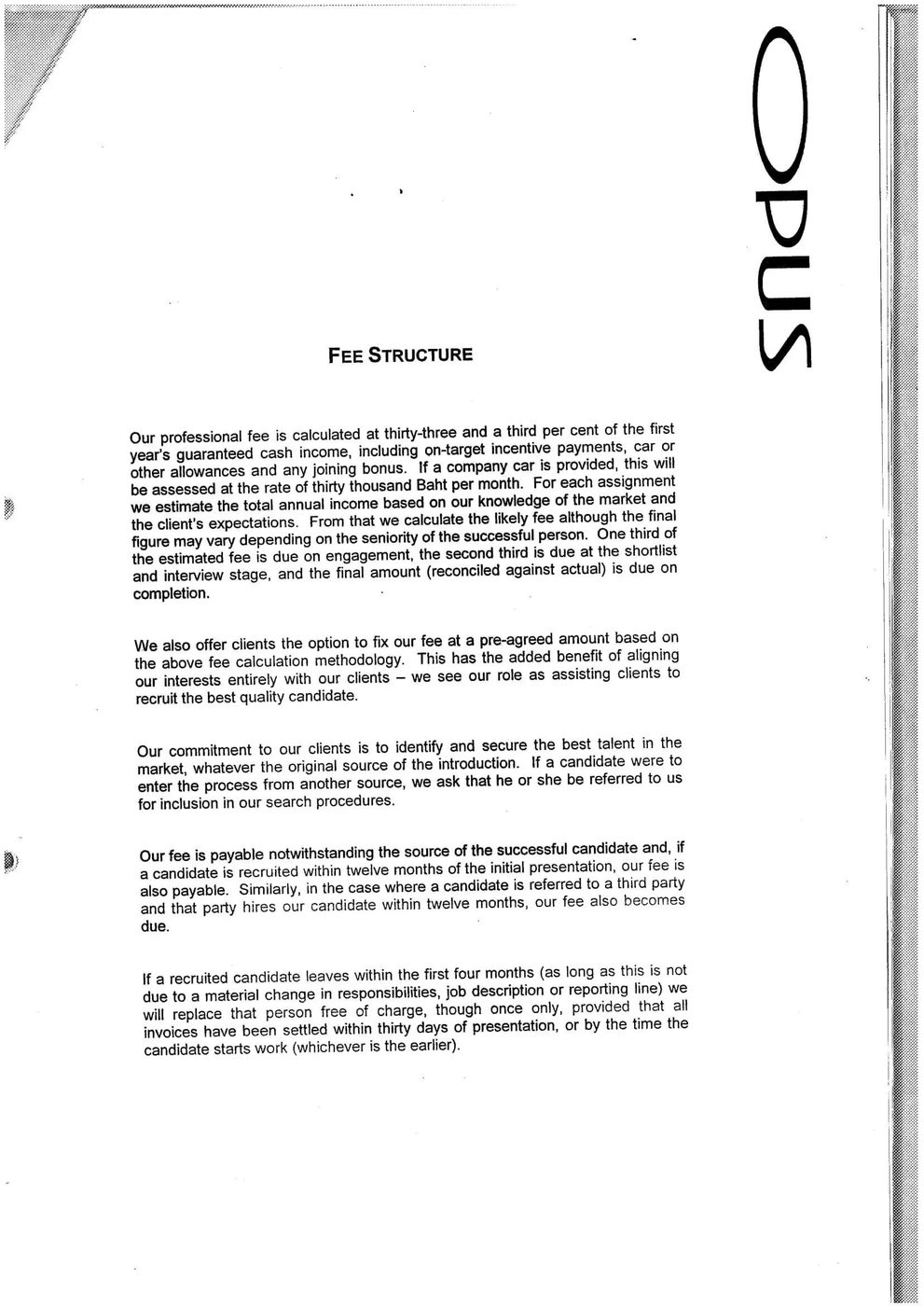
The T&C also included the fact that we would not refund money to clients if the candidate provided failed to pass probation but instead would replace that candidate one time. This was also in the contracts(see 23 attached).Gary would claim in court (below) he had not paid me yet because he only ever paid me after the candidate passed probation in case we had to refund money. Another lie.
This from Opus’s T&C:
“If a recruited candidate leaves within the first four months (as long as this is not due to a material change in responsibilities, job description or reporting line) we will replace that person free of charge, though once only, provided that all invoices have been settled within thirty days of presentation, or by the time the candidate starts work (whichever is earlier).”
He was lying as shown in black and white in his own contracts which were presented for the judge to see.
Part 7. A Snapshot of Labour Court Lies
This lie, like many others, he repeated in both his prepared statement(12)and under oath in his testimony(13)in court.
I have attached an attempted inventory(21 & 22)of all the lies he told in both but here is a sample of what he said in court:
a. “I came to Thailand because I disliked Japan…and would go back if I didn’t like it”(12 p2)
I provided my original application letter and CV which clearly showed I came to be with my girlfriend (see 1). I said nothing about going back if I did not like it.
I think he was just trying to portray a temporary, uncommitted nature to my stay in Bangkok which helped his idea that I wanted to be a “freelancer”.
b. “He asked me to work as a freelance”(12 p2)
Where? When? The word “employee” or “employment” was used in every written and verbal communication including my contract, the articles he wrote about me; and verified by my witnesses. It was how I was introduced to colleagues and to clients.
There was no mention anywhere of freelance and he provided no evidence of it. He only raised this term after he told me to leave the office. And if this were true it means freelance, which is illegal for a foreigner, was his idea and he would have been asking me to break the law.
c. “He did not pay me salary because he did not accept me as an employee” (12 p3) and “If successful he would get me a work permit but I was not successful(13, p3)
According to my contract(1),Gary didn’t pay me a salary initially due to the company’s financial situation; my compensation was commission-based “for now.” He promised full employee benefits soon, though I only received partial benefits during that period. Despite this, I performed the same work as other employees, followed the same rules, and was always referred to as an employee in all communications. I was never called a freelancer.
Gary, having lived in Thailand for years, knew that foreigners couldn’t legally be freelancers and needed employer sponsorship. In court, he stated he would secure a work permit for me if I was successful, just as he did for Gary McEwan. If I were truly a freelancer, there would be no need to mention a work permit — it wouldn’t be his concern.
The difficulty in getting my work permit arose because all the Thai employees quit, making it legally impossible to hire another foreigner. Their departure was due to Gary’s actions. Nonetheless, my contract and verbal agreements, which were also reiterated in court, outlined employment as well as a career path for me.
I was the top biller at Opus, passed probation, was tasked with running the HCMC office, and successfully placed candidates for CEO and GM roles. If I was “not successful,” why did I complete such critical roles? He asked me to handle a CEO position for KWH Pipe, which I successfully filled with a man called Burin Kunatippapong. If I was not capable, why trust me with such important responsibilities?
d. “There were times when I did not come to the office”(12 p3)& “ If I did not want to come to office I did not have to submit leave request”(12 p3)
I came to the office everyday as I was expected to the same as any other employee. There were a couple of occasions I was late and the office manager called me to check as ordered by Gary. As there was no clock in system the only way to prove this was through my witnesses(see 14.Chottiwut’s testimony).
He also said in the Article (11) I used the office equipment “every day” and “on company time”. My emails and database entries would also prove it. Conversely, he provided no proof or witnesses for this and all his other claims.
The only time I did not come to the office was when I had to go to Vietnam for him. I was there every other day. The one time I had to go home early because I was sick I had to ask his permission.
I even had keys for the office that he demanded I return the day he fired me. Why would a “freelancer” even have keys?
e. “Work was in stages and so fees could be shared”(12, p4)
It strictly followed the agreement in my contract(1)with no deviation. Witness testimonies and my contract confirmed this and none of the projects completed followed any other pattern. He only claimed this was how it worked for the projects he had not yet paid me for. I provided bank statements to prove there had been no previous examples of this, as well as my contract.
f. “If candidate did not pass probation we had to refund money to client”(12, p4)
It never happened and was proved by his own contracts which we court ordered(23)and also the BD pack(20)and further by witness testimonies(14, 15).
These said we would replace a candidate who did not pass probation, nothing else. Money was never refunded to a client. I believe he said this in order to justify his lie (below) about why he had not paid me yet.
g. “He thought I knew many expats but didn’t …and so had to get all my candidates from the Opus database”(12 p5)
Expats had nothing to do with my role. It was to complete “assignments” no matter the nationality.
90% of my candidates were self-generated including 2 out of the 3 for the three remaining projects and I provided candidate statements to this effect.
I was still owed money for completing projects for 3 companies — Primus, DKSH and Kris Energy.
The DKSH candidate was a friend of my friend who had never heard of Opus. The Primus successful candidate, Alex, was someone Thailand based I cold called and was still in touch with. He was happy to provide a statement. The Opus database would also have shown. These candidates had never even heard of Opus before I called them.
I got some (unsuccesful) candidates from the Opus database the same as any other employee. If I were really a freelancer, I could not use the Opus database.
He also said(13, p7)it was up to me if I wanted to take other employees to business meetings. No — it was an office rule as witnesses testified. Gary decided who would go with me. If I was a freelancer I could not instruct his staff to come with me.
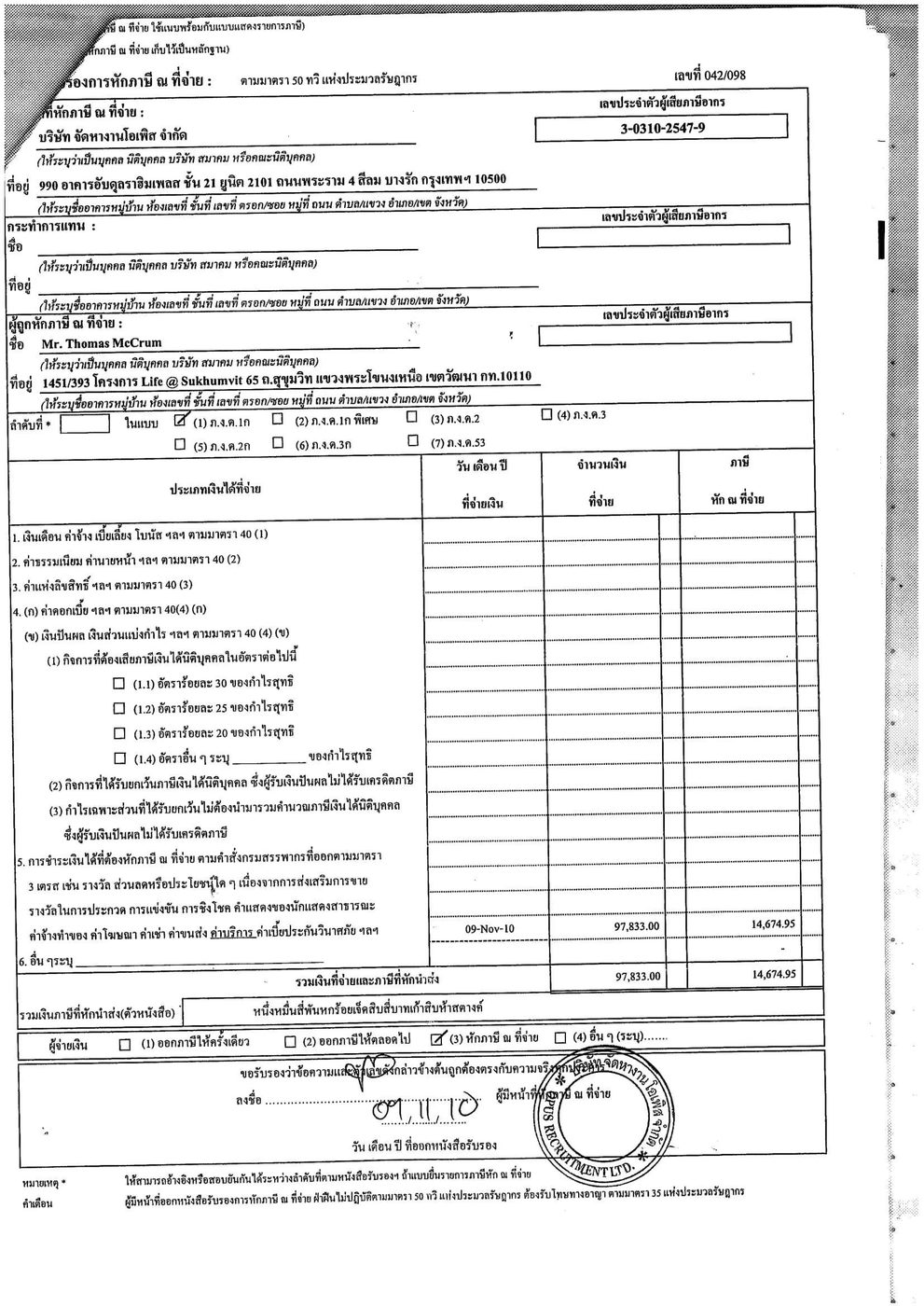
h. “He gave me a WHT certificate for my PIT, it was in English and it was clear that I was a freelancer and they did not deduct social security because I was freelancer and I was aware of this”(12 p6 & 13 p5)
He paid my tax and, I thought, social security for me and gave me a form in Thai.
We provided these documents in black & white to show he was lying.
I was not aware, and it was not “clear” I was a “freelancer”. He simply made this up for the court.
See one example of the Thai form he gave me every month which were all submitted as evidence.(24).Wanna the office manager should have been able to confirm this (she handled the payments) but, of course, did not show up to testify on the day she was due to.
ชืณทีจ่ายใช้แนบพร้อมกับแบบแสดงรายการภาษี) โกภาษีณทีจ่ายเก็บไว้เป็นหลักฐาน)
เลขที042/098 ร้องการหักภาษีณทีจ่าย:
ตามมาตรา50ทวิแห่งประมวลรับฎากร เลขประจําตัวผู้เสียภาษีอากร ทีหักภาษีณทีจ่าย: 3-0310-2547-9 บริษัทจัดหางานโอเพิสจํากัด (ให้ระบุว่าเป็นบุคคลนิติบุคคลบริษัทสมาคมหรือคณะนิติบุคคล)
ทีอยู่990 อาคารอับดุลราชิมเพลสชัน21ยูนิต2101ถนนพระราม4สีลมบางรักกรุงเทพฯ10500 (ให้ระบุชืออาคารหมู่บ้านห้องเลขทีชันทีเลขทีตรอก/ซอยหมู่ทีถนนตําบล/แขวงอําเภอ/เขตจังหวัด)
เลขประจําตัวผู้เสียภาษีอากร กระทําการแทน: ชือ (ให้ระบุว่าเป็นบุคคลนิติบุคคลบริษัทสมาคมหรือคณะนิติบุคคล) ทีอยู่
(ให้ระบุชืออาคารหมู่บ้านห้องเลขทีชันทีเลขทีตรอก/ซอยหมู่ทีถนนตําบล/แขวงอําเภอ/ขดจังหวัด)
เลขประจําตัวผู้เสียภาษีอากร
ผู้ถูกหักภาษีณทีจ่าย:
: Mr.ThomasMcCrum (ให้ระบุว่าเป็นบุคคลนิติบุคคลบริษัทสมาคมหรือคณะนิติบุคคล)
1451/393โครงการLife @Sukhumvit65 ถ.สุขุมวิทแขวงพระโขนงเหนือเขตวัฒนากท.10110_ (ให้ระบุชืออาคารหมู่บ้านห้องเลขทีชันทีเลขทีตรอก/ซอยหมู่ทีถนนตําบล/แขวงอําเภอเขตจังหวัด)
(4)ภ.ง.ค.3 (2)ภ.ง.ค.1กพิเศษ 4(1)ภ.ง.ค.1ก 1(7)ถ.ง.ค.53 1(5)ภ.ง.ค.2ก_(6)ภ.ง.ค.3ก ภาษี วันเดือนปี จํานวนเงิน ประเภทเงินได้ทีจ่าย หักณทีจ่าย ทีจ่ายเงิน ทีจ่าย
1.เงินเดือนค่าจ้างเบียเลียงโบนัสฯลฯตามมาตรา40(1)
2.ค่าธรรมเนียมค่านายหน้าฯลฯตามมาตรา40(2) 3.ค่าแห่งลิขสิทธิ์ฯลฯตามมาตรา40(3) 4.(ก)ค่าดอกเบียฯลฯตามมาตรา40(4)(ก) (ข)เงินปันผลเงินส่วนแบ่งกําไรฯลฯตามมาตรา40(4)(ข)
(1)กิงการทีต้องเสียภาษีเงินได้นิติบุคคลในอัตราต่อไปนี
D(1.1)อัตราร้อยละ30ของกําไรสุทธิ 0(1.2)อัตราร้อยละ25ของกําไรสุทธิ ⼞(1.3)อัตราร้อยละ20ของกําไรสุทธิ _(1.4)อัตราอืนๆระบุ_ ของกําไรสุทธิ (2)กิจการทีได้รับยกเว้นภาษีเงินได้นิติบุคคลซึงผู้รับเงินปันผลไม่ได้รับเครดิตภาษี (3) กําไรเฉพาะส่วนทีได้รับยกเว้นไม่ต้องนํามารวมคํานวณภาษีเงินได้นิติบุคคล ซึงผู้รับเงินปันผลไม่ได้รับเครดิตภาษี
5. การชําระเงินได้ทีต้องหักภาษีณทีจ่ายตามคําสังกรมสรรพากรทีออกตามมาตรา 3เตรสเช่นรางวัลส่วนลดหรือประโยชน์ใดๆเนืองจากการส่งเสริมการขาย
รางวัลในการประกวดการแข่งขันการชิงโชคคําแสดงของนักแสดงสาธารณะ
ค่าจ้างทําของค่าโฆษณาค่าเช่าค่าขนส่งค่าบริการค่าเบียประกันวินาศภัยฯลฯ
14,674.95 97,833.00 09-Nov-10 6.อืนๆระบุ
รวมเงินทีจ่ายและภาษีทีหักนําส่ง
14,674.95 97,833.00 หนึงหมืนสีพันหกร้อยเจ็ดสิบสีบาทเก้าสิบห้าสตางค์ รวมเงินภาษีทีหักนําส่ง(ตัวหนังสือ)
(2)ออกภาษีให้ตลอดไปZ(3)หักภาษีณทีจ่าย
(4)อืนๆ(ระบุ)..... 7(1)ออกภาษีให้ครังเดียว ผู้จ่ายเงิน
ขอรับรองว่าข้อความแลอรู้ใหมหักล่าวข้างต้นถูกต้องตรงกับความจริทุกสิ้นจัดหมา โอเพิ
ลงชือ.
09,I1,10
วันเดือนปีทีออกหนังสือรับรอง * ให้สามารถอ้างอิงหรือสอบยันกันได้ระหว่างลําดับทีตามหนังสือรับรองฯถ้าแบบยึนรายการภาษีหักณทีจ่าย หมายเหตุ*
ผู้มีหน้าทีออกหนังสือรับรองการทักภาษีณทีจ่ายฝ่าฝืนไม่ปฏิบัติตามมาตรา50ทวิแห่งประมวลรัษฎากรต้องรับโทษทางอาญาตามมาตรา35แห่งประมวลรัษฎากร
คําเตือน
WHT certificate in Thai, not English as he claimed in court.
i. “We had an argument about commissions and so I left the office”(12, p6)
Again, Wanna, the office manager was there and knew this was not true. The emails he sent to me and DKSH also told a different story, as did the articles he wrote. There was no argument about commissions– he told me to leave based on one email, or I was “fired on the spot” according to his article.
j. “ Opus won the Primus project so I was only due a lesser fee”(12, p7)“Primus was a previous client”(12, p7)
See the statement from Primus(25)contradicting this. I won the assignment as a representative and employee of Opus. I also provided a bank statement to show I received full fee for the first stage consistent with my winning the project as per the T&C of my contract.
Separately, is claim that Primus was a previous client was both (a). untrue and (b). irrelevant:
(a) Theex-Head of HR for Primusconfirmed to me she had met with Gary in 2009 but decided not to use him(26)and instead used two other firms:
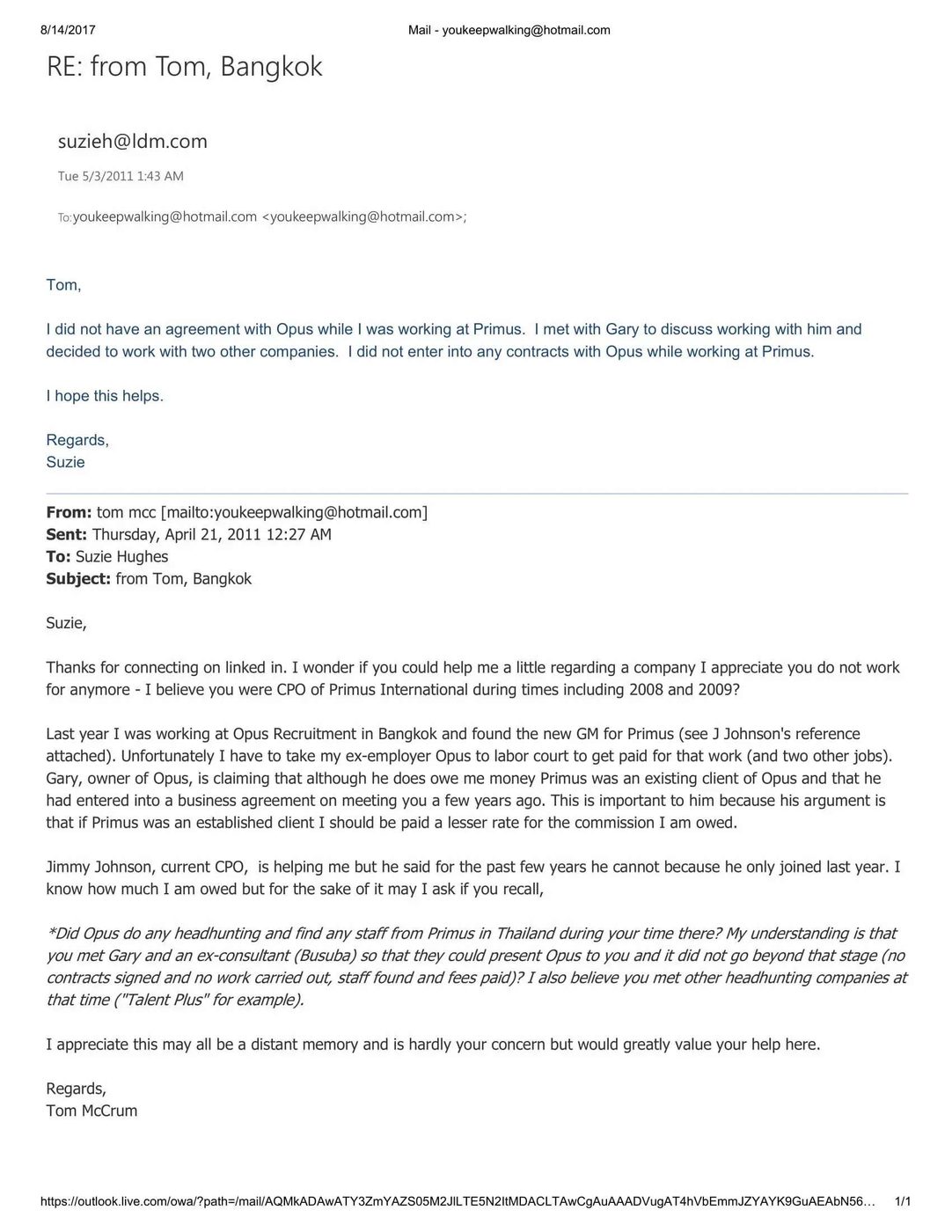
Again, it did not even matter if Opus had done work for them before because, as per my contract,(1)I was paid a full fee if I could retain “assignments” and not new clients.
Gary was just trying to confuse and deceive the court.
k. “I did not achieve work to completion and he joined and completed the work on Primus and KrisEnergy by registering them with labour office and following up with a satisfaction survey” (12, p7) (13, p9 &10) & “He did half the work” (13, p10).
Satisfaction surveys did not exist and had no connection to providing staff to clients anyway. They were never used, and not part of my contract , or the client’s contract.
Registering candidates with labour office was, Wanna, the office manager’s job. She did it for every project. Gary never did it — it was an admin role and needed a Thai speaker. It was a simple process and took minutes. This was also confirmed by other employees in their court testimony.
From(27)you can see that I contacted Alex to get the relevant information while still at Opus. This was after Wanna had called him, but her English was not good enough to communicate with him. Instead, I emailed him and got the information. It was completed on November 18th before Gary fired me.
Primus’s Head of HR provided me with the below:
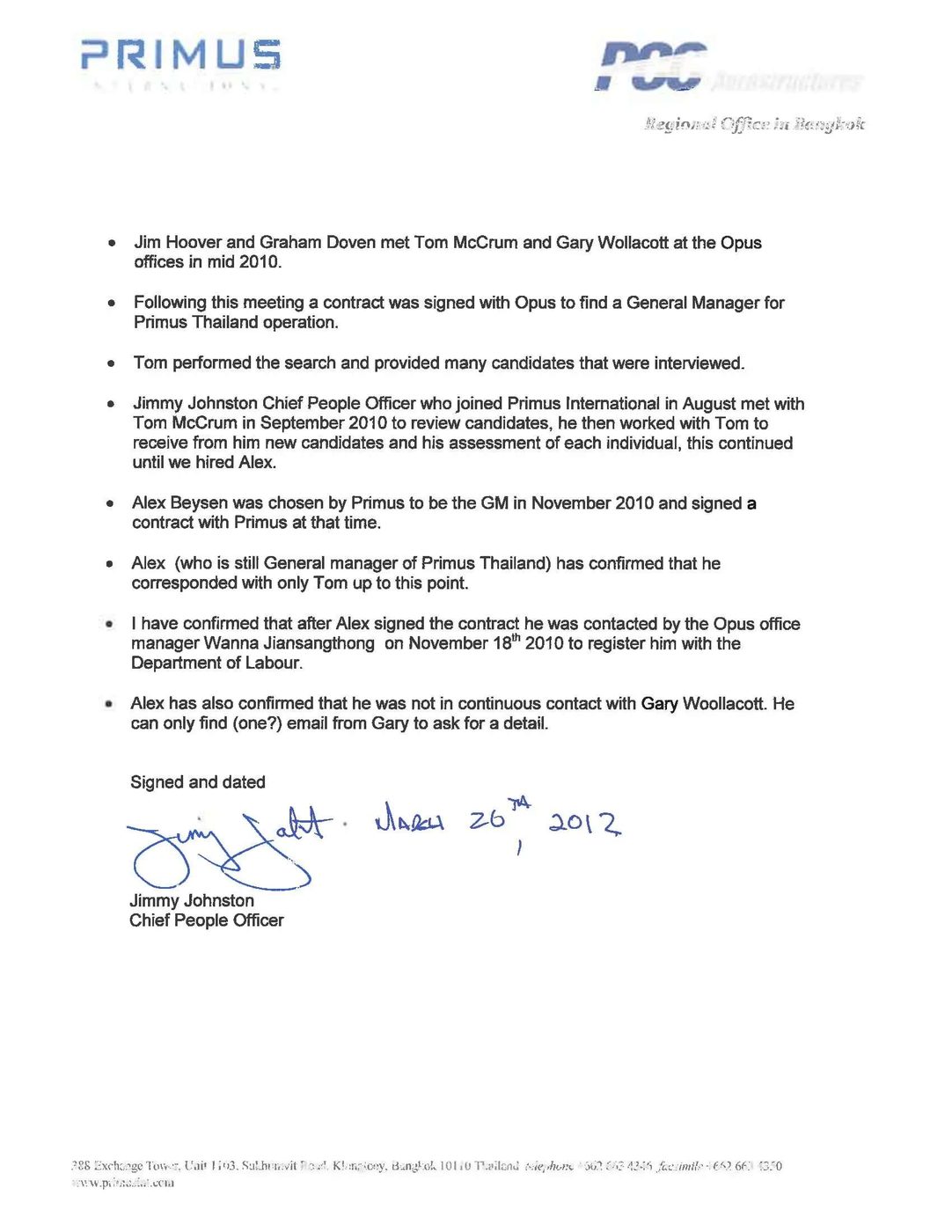
Alex, who provided these emails to me, confirmed that he was only contacted once by Gary by email. Gary claimed under oath that he was in continuous contact with him and spent “two to three months to complete such unfinished work for those two companies’”(13, p10).
I completed the work and also had statements to prove it. Pattarin, my succesful candidate at Kris Energy, said she did not even know Gary and had never talked to him(28 ).Steve Clifford, Kris Energy CFO, also sent me an email(29).So did Kevin at DKSH(29b)
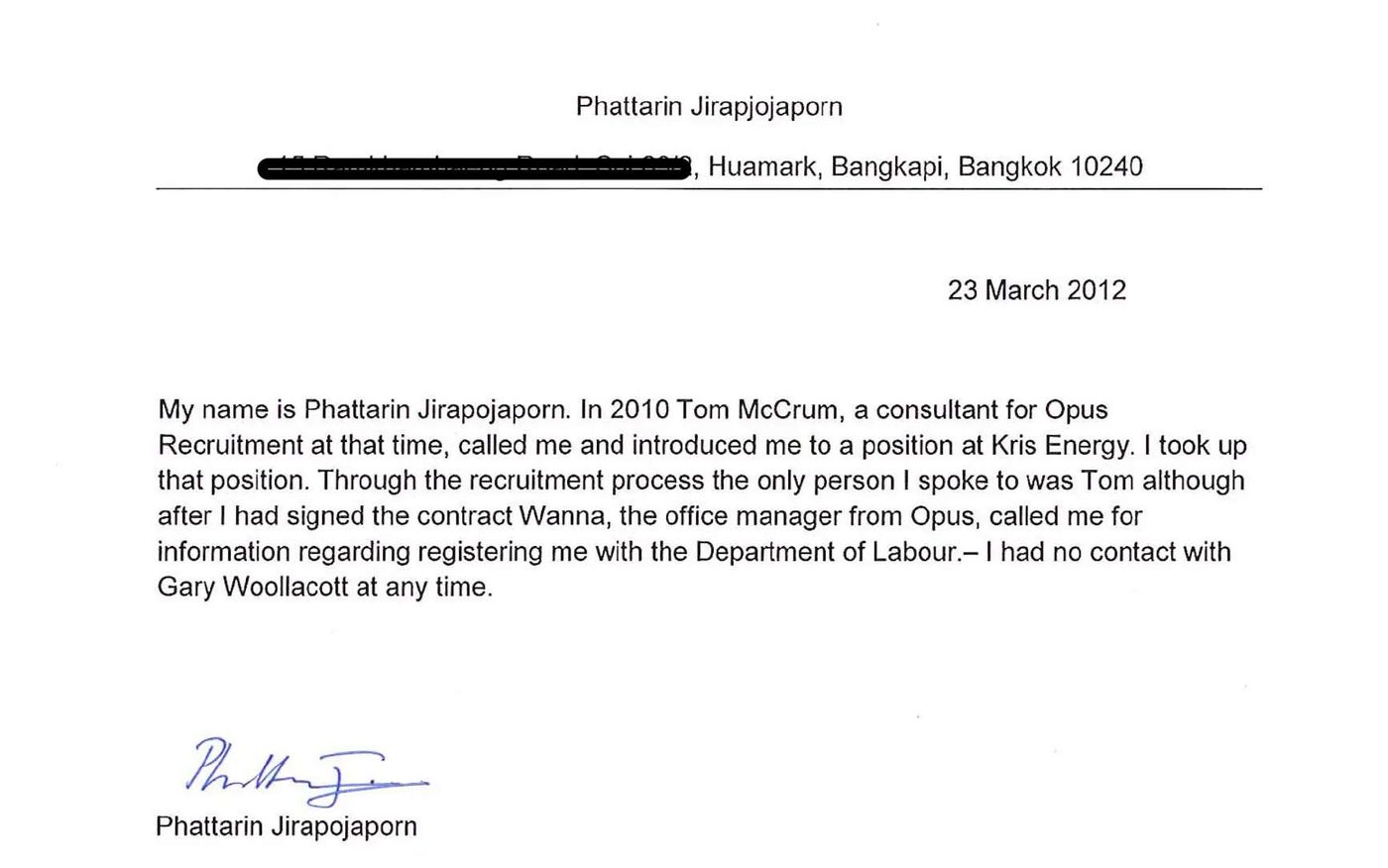
Gary’s contribution to the three projects was utterly minimal. He met the CFO of Kris Energy for a coffee after Ian Thornhill of KPMG referred him on then did nothing else. He joined me in an initial meeting with Primus then did nothing else except one admin email to Alex months after he had started (because the office manager could not speak English well). He did nothing for the DKSH project.
When Alex accepted the Primus role, Gary was on safari in Africa with a friend. He had no idea who Alex or any of the other candidates were.
l. “Payment delayed due to guarantee period”(12, p7)
Completely made up for the court — not part of the Opus T&C, my contract or past pattern. Also, confirmed by past payments which were always based on receipts and paid at/around the end of month.
m. “He did not send me to Vietnam, I asked to go”(13, p7)
See Yen’s witness statement(13).He sent me there to look into running that office and she booked the hotel for me. I also had to renew my tourist visa which he was fully aware of. I interviewed a candidate called Etienne Laude there for a job in Thailand(see 30b).
Gary actually came over to Vietnam with me and paid for the trip including hotel(30).He also wanted me to attend a chambers of commerce event with him and paid for that.
However, when asked at court why he paid for me if I was not an employee, he said I had had no money so he paid by credit card and I gave the money back to him later. Completely untrue and surely only the naïve would accept this?
See email from hotel below.
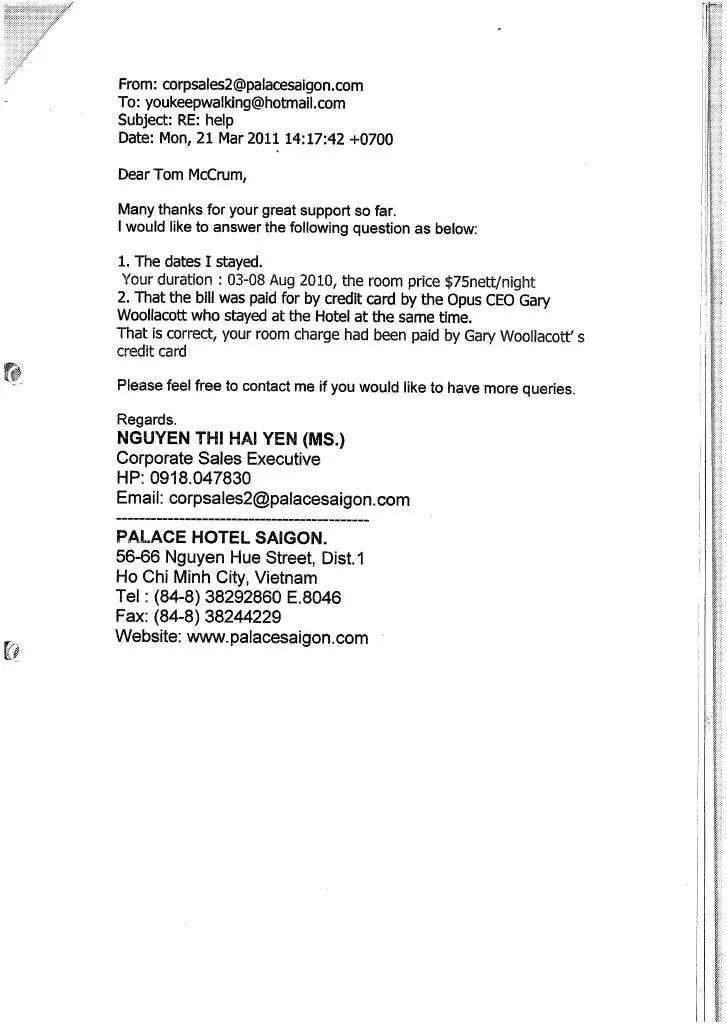
Gary said in court I went to Vietnam on a holiday and did no work there
(40).He claimed the fact we went at the same time and stayed at the same place was coincidence.
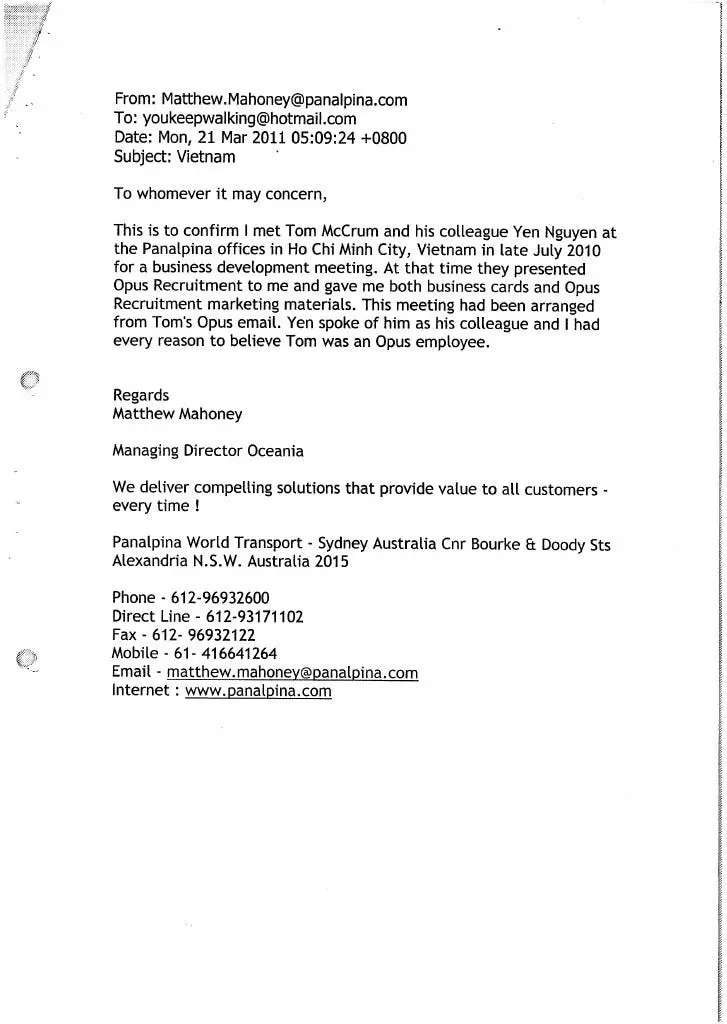
The Country Manager of Panalpina Vietnam gave a witness statement(31).
I later also recalled that Gary was counter signatory to my passport application in 2010 and entered that he was my “employer” on the form (section 10). I requested a copy of this form under FOI from HMPO. It is a crime to lie on this form in UK law. My lawyer said this would be very good evidence. However, in August 2017, HMPO told me the documents had already been destroyed(43).
My testimony to court is attached and reflected the truth as I understood it and was led to understand it by Gary(32).
Although I think another law firm could have written a more aggressive and thorough testimony it was still based in truth and had an abundance of supporting evidence. Gary, in contrast, had provided no witnesses and little to no documentary evidence.
Part 8. The Judgment
The judge decided, in May 2012, that I was not an employee(33 — in Thai).
This was because of the below reasons:
• My contract was different from others in the office
• My remuneration was not salary.
• Gary did not provide me with a work permit or social security
• There was no proof I was under his command
• The articles did not name me
• The business trip to Vietnam was “a duty” (?)
• The Tax certificate is not for salary but for commission.
The court had now decided it was a civil court matter and not a labour court matter.
I was disgusted.
Disgusted in both the judgment and its lack of attention to the evidence and the lies. An awful man, it seemed to me, had just been helped by the legal system. It seemed a cowardly and wilfully ignorant decision.
My lawyers were equally baffled. The labour court judgment disregarded substantial evidence and substance and made little sense. It was difficult for them to understand the judge’s decision:
• Wages can legally be commission contrary to what the judge ruled.
• My contract may have been different from those of the other people in the office but was still an employment contract. It did not need to be identical (and, needless to say, I did not know what anyone else’s contract looked like when I joined). In Thailand contracts do not even have to be written.
I saw many genuine freelance contracts in my KPMG job. They must be very specific and cannot use words like “employment” or outline career paths and must make clear that you cannot use company equipment, resources and IT.
• And they can only be given to Thais because foreign freelancers cannot exist legally.
• It seems “I” did not pay tax or social security as an employee — but only because Gary paid it for me like any other employee and gave me a pay slip in Thai, and not in English as he told the court and as we showed to be the case.
Even the tax he withheld turns out to be wrong anyway. 15%, as I now know (but had no idea then), only applies to non-residents who provide a service but reverts to standard PIT rates after 6 months. I was there almost 11 months and so was resident after 180 days.
And the articles “did not name me”? This “employee” and “colleague” who supposedly trashed him “on company time” who he “fired on the spot” just “a couple of days before writing the column” (from Dec 2010) and via whom he had “received a labour court summons” (April 2011 article) and who he had invited to “negotiate”. There were only 4.5 other employees total in both offices at that time, none of them male, none of them had been fired then, none matched this very specific narrative…. except me.
Who then was this mysterious “employee” he had fired on the spot in November 2010 and who was taking him to labour court in early 2011?
And what evidence did Gary provide?
His word, copies of a few other employees’ contracts, and no witnesses. Nothing else.
Yet this was enough?
We presented ample evidence of his flagrant lies, demonstrating not only the extensive lack of credibility in his testimony but also providing sufficient grounds for his prosecution for perjury.
I had had witnesses to verify my story and contradict his, I had contracts and Opus’s own materials, I had emails, I had Gary’s own words in articles and emails, bank statements etc. These not only supported the belief I was hired as an employee, was expected to behave as an employee, did behave as an employee etc. but showed he repeatedly lied to the court on a range of matters.
Moreover, if I was not an employee then what was I?
Gary said in his statement that he asked me to work as a freelancer. If so, he would have been asking me to do something that is not just illegal but also legally impossible in Thailand. I was not a freelancer because legally you cannot be if you are a non-Thai. As a foreigner, you need a work permit, minimum income and Non-B visa — none of which you can get as a freelancer.
I had not yet gotten a work permit but there was no way a “foreign freelancer” could have. I was depending on and waiting on Opus, my believed employer, to give me one as promised. Gary, the labour law “expert”, knew this very well.
And his attempt to play with words and say I was not yet a “permanent employee” and this meant I was consequently “freelance” was not only illogical and illegal but flagrantly pernicious and dishonest.
Gary also had the audacity to ask the court to rule that I should pay his legal fees. This, at least, the court did not agree to.
As mentioned, my lawyers were confused and disappointed by the judgment(34).They thought it was weak and so lodged an appeal(35)and were confident it would be overturned.
In the end it would take 3.5 years for the appeal to be heard.
Part 9. Tax Evasion
I just had to get on with my life which I did. I would ignore Gary for the next few years.
Except on one issue.
Apart from his treatment of me and various others, Gary also evaded taxes. I personally observed him do this regarding work I did to find a Thai CEO for a Finnish company called KWH Pipe which had a manufacturing facility in Thailand. I did the work in Bangkok for the Thai entity and found a Thai candidate to become CEO. However, Gary filed this as work done offshore in order to evade the tax due.
I had also seen his fraudulent expenses claims and, via my lawyers, had seen his balance sheets too.
We saw from the balance sheets that he repeatedly loaned money from Opus to his empty second company, BMGW Co. Ltd, then wrote off the loans — again to avoid tax.
He lived a very comfortable life in Bangkok. He made a lot of money from the hard work of other people, work done in Thailand, yet was not contributing full taxes to the country he was a guest in.
This hypocrisy nauseated me.

Bangkok Brits Narration
I decided to report this to the Revenue Department in June 2012 via their online system (No: 226470/55 Date: 25/6/2555 13:27:01). In September 2012, I received the encouraging word that a tax audit would take place.
I presume they warned Gary in advance and mentioned my name because in December of that year I found out that he had made another complaint about me but this time to KPMG Global. It was the same complaint he had made to the COO and, again, went nowhere.
Moreover, I was hopeful that the Revenue Department would prosecute him where the labour court had failed.
However, in early 2013, Wanna, the Opus office manager, told my witness Chottiwut that Gary had paid a bribe to the Revenue Department inspectors so that they would not take a closer look at his accounts.
He escaped the audit.
Part 10. Appeal Court Decision
And, in February 2016, my law firm informed me the Supreme Court agreed with the court of first instance(36).
They could not explain why. The judgment of the first court would stand.
It seemed that Gary had gotten away with theft and with multiple instances of perjury in court while offering no witnesses and no documentary evidence except another workers’ contract.
But there was still the civil court, right?
Unfortunately, my law firm informed me of the judgment three months late while dishonestly claiming they had, just that day, received the judgment(37).As a consequence, the statute of limitations had passed for me to take it to the civil court as it had to be filed within three months of the previous court’s decision.
Now the Thai court, and my law firm, had both let me down.
Part 11. Criminal Court Accusation
I was very unhappy with the labour court.
However, what could I do except get on with life which was what I did.
I had had no contact with Gary since late 2010. The trial had been in March 2012 and the judgment in May 2012. The Supreme Court judgment was rendered in November 2015. I had also taken no further civil court action although I wanted to.
I had seen Gary once at a networking event but ignored him.
However, on Monday January 30th 2017, I came into my office to find a criminal court plaint(38)lying on my desk.
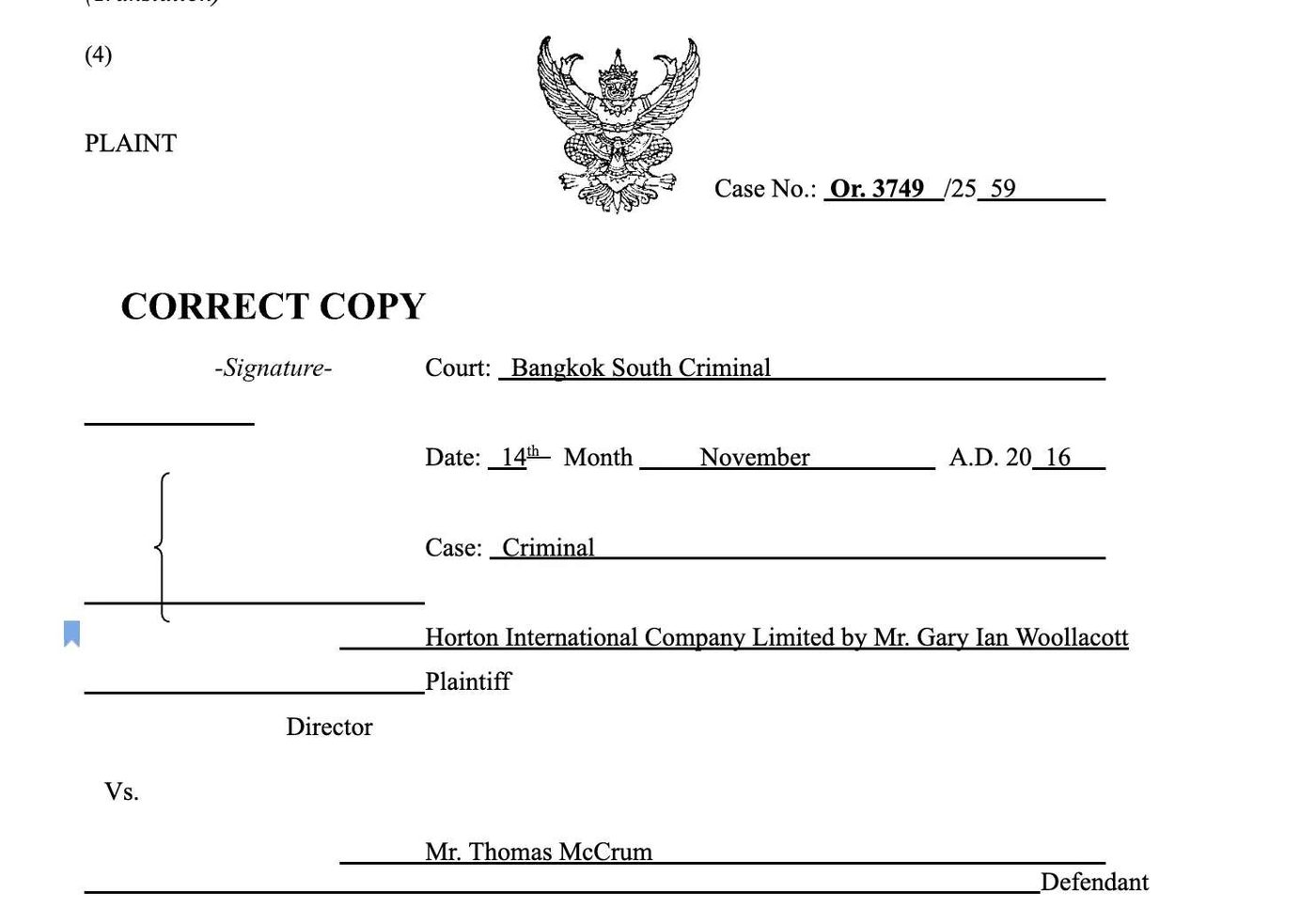
It had been issued in November 2016 but I was receiving it 2 months late (I do not know why). Gary had filed a criminal complaint against me saying I had lied in labour court by claiming to be an employee. He outlined eight things I had said in the court in 2012 related to this and said all of them were lies. The first settlement meeting was to be just 24 days later.
I was shocked and angry. The creep had no shame.
I scrambled to find a lawyer who took a look at the plaint and told me he believed it was non-prima facie. This lawyer, Pisut Rakwong, sent a junior lawyer to the settlement hearing. Gary and his lawyer were there(39).At the settlement meeting Gary said he would drop the claim if I gave him 6.4 million baht and a letter of apology.
My lawyer declined on my behalf and requested we move on to the inquiry hearing which had already been set for March 6th, 2017, in the original plaint. On March 6th Pisut went to the inquiry hearing (39). He had prepared evidence and questions to cross examine Gary to get the case thrown out.
However, Gary’s lawyer said that, surprisingly, Gary could not actually be there that day because he was on a business trip overseas.
What? He had filed the complaint and had had 5 months to prepare for this date; I had had 6 weeks. However, he could not even organize his calendar to attend?
Because I knew his character, I did not believe this story. I called his home phone number the same day…. and, of course, Gary picked up, he was not overseas.
I informed Pisut however he said that the court would not care about this. I am sure Gary was just doing this to get me to waste my time and money. This was his character. However, that the court would not care about his lies, and in a perjury case, was troubling to me though, by then, not surprising.
At the same inquiry hearing, my lawyer took the chance to ask Gary’s lawyer why Gary was doing this. The lawyer told Pisut he was doing it because he believed I had reported him to the Department of Business Development for having an illegal nominee shareholder setup in his company.
Gary does in fact have an illegal nominee shareholder structure; however, I had not actually reported this. He was just guessing.
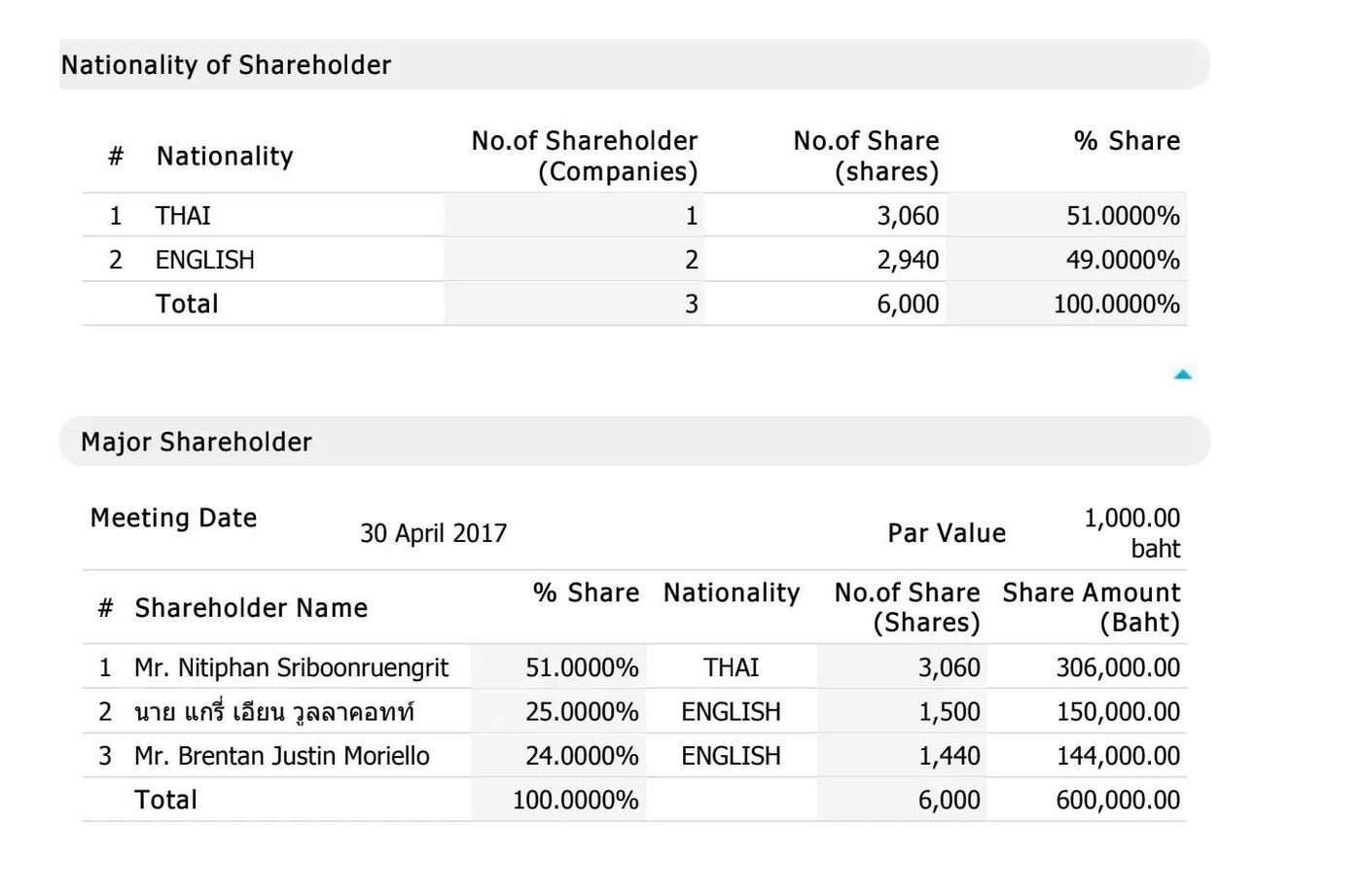
Gary knew I had told no lies in court. He had told an abundance of them in order to steal from me.
I now found out that his criminal court charge was motivated by a mix of guesswork and revenge for someone reporting his illegal company structure and I appeared to be his best guess. I could say I was shocked and disgusted by his lies and by his hypocrisy but, of course, I was no longer shocked and disgusted by anything he did.
The inquiry hearing had to be rescheduled.
There was one more settlement meeting arranged at which Gary turned up (39). He complained that because I did not attend (I was not required to) that I was trying to flee the country. Even though he had not turned up for the inquiry hearing, and had delayed the case for two months, he was accusing me of delay and looking for a chance to escape Thailand. I had no intention of going anywhere.
At the rescheduled inquiry hearing my lawyer cross examined Gary for 3.5 hours. He repeated many of his claims at labour court but with a few additions(40).
When asked why he confirmed employment with me in our emails he said there must have been some sort of “misunderstanding”.
When faced with Yen’s testimony he refused to answer the question. Instead, he bizarrely accused Yen of stealing from him and said he had asked her to resign.
When I told her about his comment, Yen was disgusted and responded with more information about what Gary had done in Vietnam(41)
When asked why he wanted someone he knew did not have a work permit to work for him he replied he thought I must have had a work permit from somewhere else. As I had just arrived in the country, and he had promised me a work permit, and we had mails to show this, it was an obvious lie.
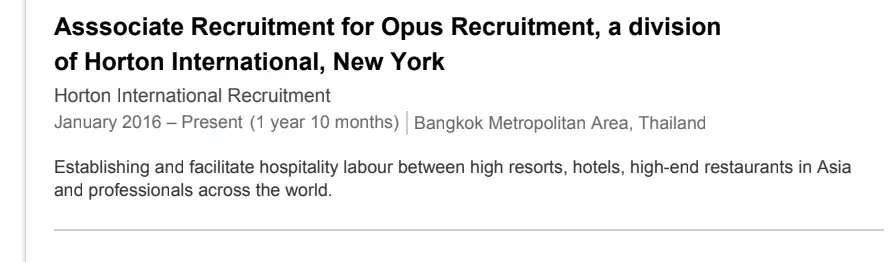
He was also asked about two foreigners who appear to have been working for him according to social media. He said one (a recruiter called Farouk) was working on a special project as his office manager. He claimed not to know another (Marius).
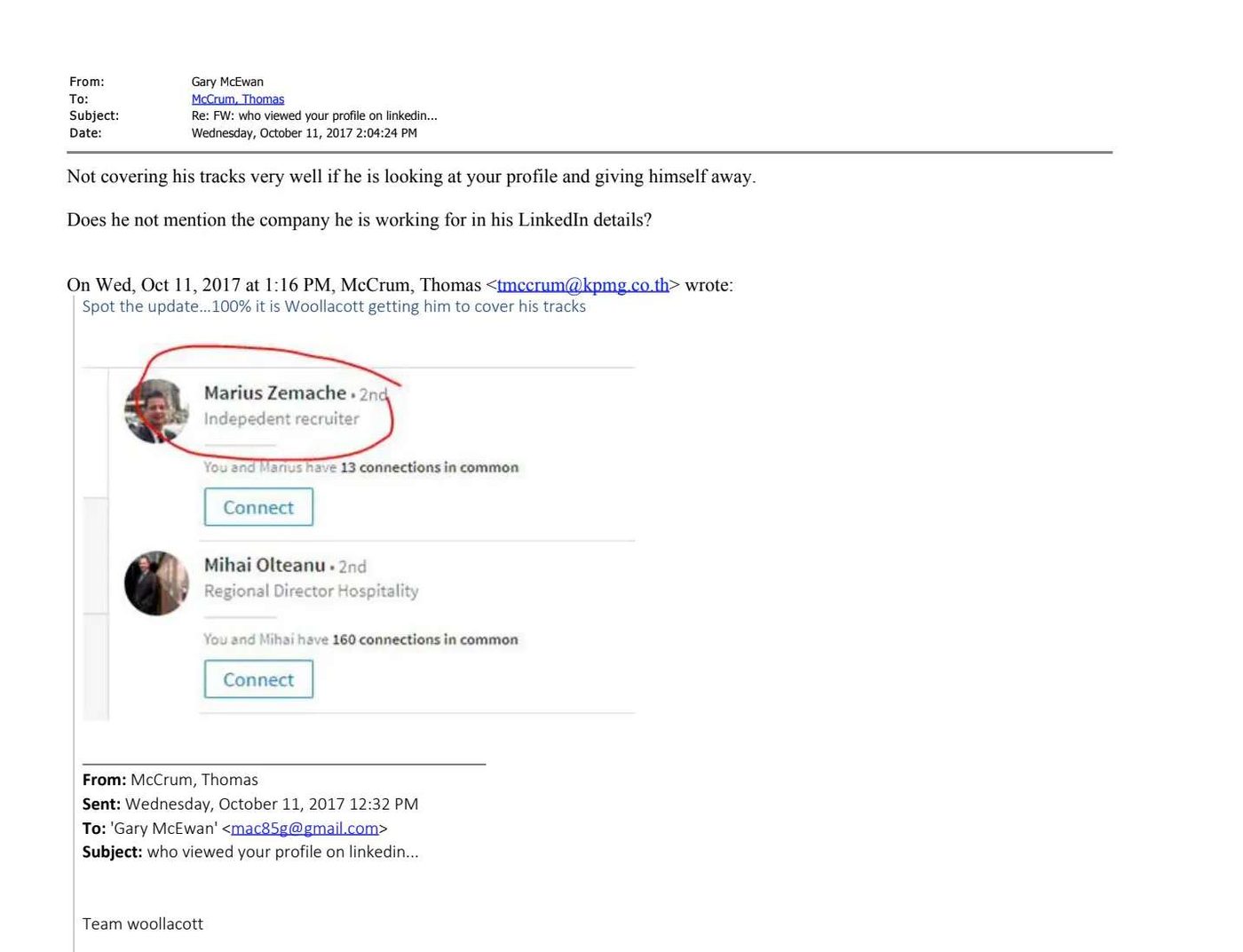
Here (42)are the social media profiles of Marius from just after that time, who he denied knowing, and another person called Mihai.
Both claimed to be working for Opus and were using Opus emails and appeared on the Opus homepage (42) at the same time that Gary was claiming in court he did not know them. Also included are email exchanges I had with them, without disclosing my name, at their Opus emails. Mihai took care in his job adverts to hide his email. Marius did not. These profiles, email addresses and posts strongly suggested that both were working for Opus.
Why lie?
Gary claimed to be a labour law expert at the enquiry hearing.
Well, if Gary was indeed a labour law expert, as he claimed, he would well know they needed work permits; that he needed 12 Thai staff and relevant registered capital to employ two foreigners in addition to himself; and would also need 75% Thai shareholding and an overseas recruitment license to recruit for outside Thailand which they appeared to be doing from their job advertisements.
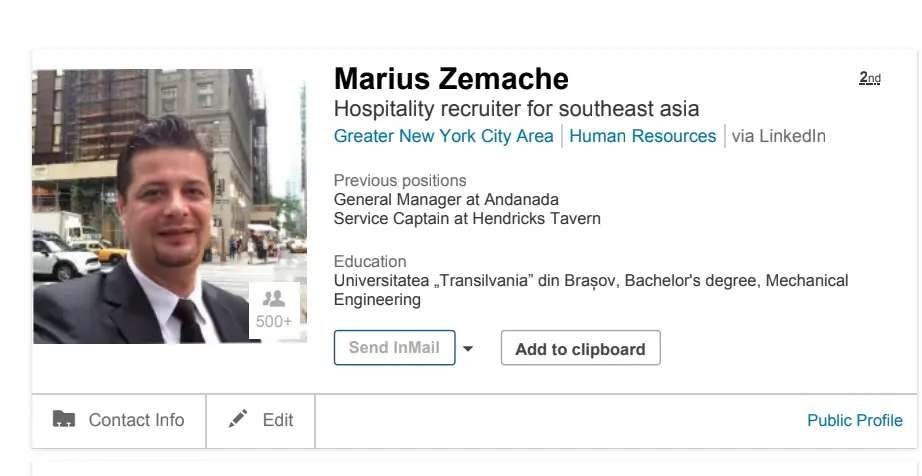
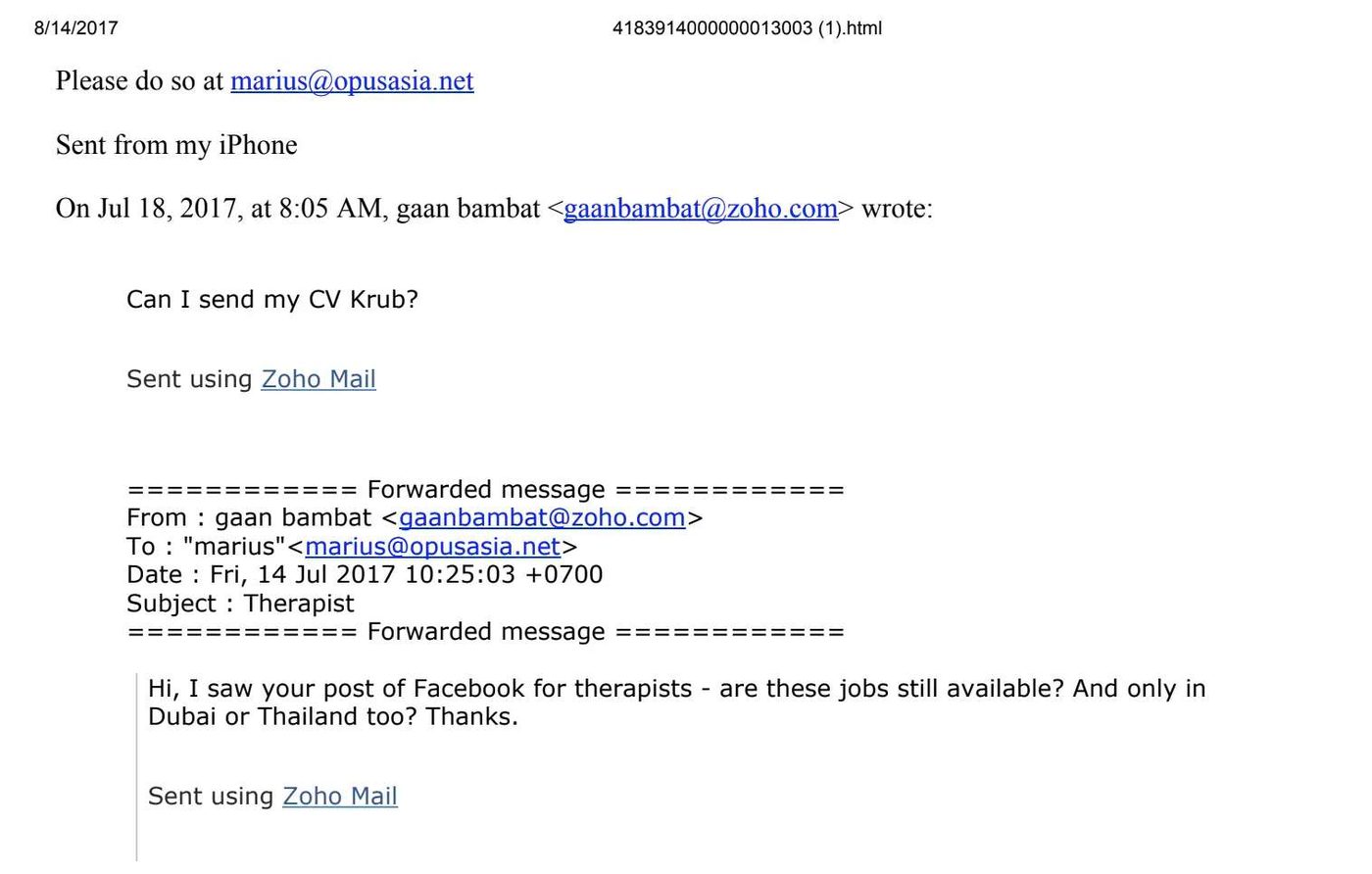
An email I sent to Marius at his Opus email who Gary would claim not to know in court
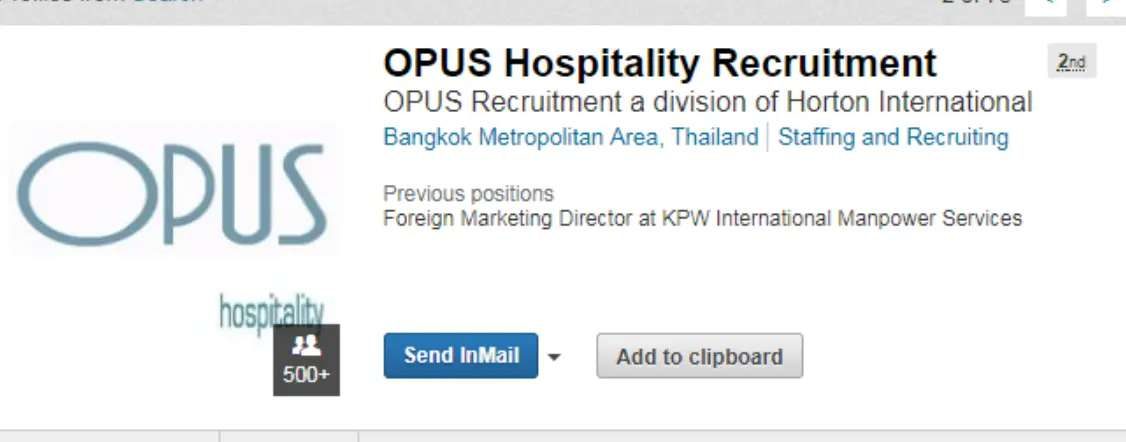
Opus Hospitality page on Linkedin
Did he have any of these required things? Did he really not know Marius as he claimed in court?
Of course not, and these guys were working for him illegally at the very same time he was pretending he did not know them under oath.
The day after the enquiry hearing both Marius and Mihai checked out my Linkedin profile and changed their own Linkedin profiles to remove any mention of Opus — they were now “independent recruiters”. I called Opus to speak to Marius and was told by the person that picked up that he was mostly working from home now.
Nevertheless, on Wednesday 17th May 2017, the judge announced that the court would accept the case and it should go to trial.
My lawyer said he thought the judge “did not take into account” the cross examination. Pisut explained that in Thailand it is easier for a judge to simply accept a case and pass it on to someone else to deal with. If he had dismissed the case, he would have had to write a justification for it which would have required effort. To hear such feedback was a sad reflection of the integrity of the legal system in Thailand.
On August 21st, 2017, I had to enter a plea at criminal court. The week before I had had to surrender my passport and post bail. I could theoretically have been remanded in custody if bail had not been granted.
I was now officially the “defendant” in a criminal court case and faced up to 5 years in prison.
Part 12. Criminal Trial
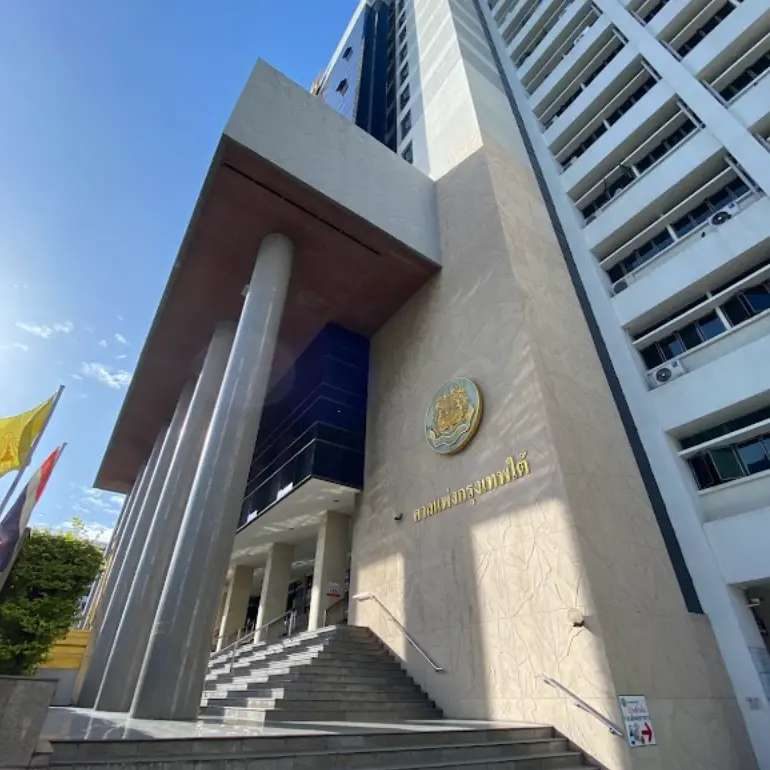
The trial was in December 2017.
2017 was a stressful year. A very stressful one. To face a criminal charge in a foreign land, instigated by someone that you know to be himself actually the criminal is an extremely difficult experience.
It impacts all aspects of your life — health, work, bank balance, sleep, relationships, etc.
I had to recontact past witnesses who had never wanted to hear about Gary Woollacott ever again. In Thai culture people are reluctant to be witnesses even if it is the right thing to do. Some refused even though I knew they hated Gary. One refused because she feared it would “damage her career” to give witness testimony against an employer. It was often a lonely process.
Wanna, the ex-office manager, would have been a very valuable witness. She knew he had fired me. She was there. She also knew of his tax evasion and bribing of the revenue department. I had only seen her once since that day. She was in a supermarket with some of her friends and saw me. Her face went bright red, she mumbled a hello and walked away. She had been in a difficult position at Opus and would no doubt have signed her false testimony under duress; but it was withdrawn before the trial, she no longer worked for him, he had bullied her relentlessly, we had been friends, and now she could make amends. And, yet, she also refused to testify.
Nevertheless, come December, I had 5 witnesses(44)albeit one a character witness and, as before, he had none.
The trial lasted 3 days. By this point, I would have liked to have had my lawyer tear him apart under cross-examination for all his lies. However, the Thai legal system seems to be very conservative and he only focused on limited and specific points. Nevertheless, it was very one sided and my witnesses repeatedly contradicted what he said. And I had a mountain of documentary evidence also.
He, in turn, had nothing except the original plaint. Nothing else.
His lawyer had nothing to ask me. At one point, he was reduced to asking me what university I went to — which was relevant to nothing.
And Gary’s performance in the court was hysterical. The entitled drama queen from Bangkok Brits.
On one occasion, he screamed out that the document my lawyer was showing to him while he was being cross-examined had been “stolen” from him by me. His eyes were ablaze. It was then calmly pointed out to the court by my side that he himself had actually provided the document to us under court order.
On the second day of the trial Gary Woollacott saw Gary McEwan, who had kindly flown in from overseas to be my witness. Woollacott said openly in the court “Oh look…it is the last piece of garbage on the beach”. I do not know if all the judges spoke English but, in Thailand, many of them get their Masters degrees overseas. I believe some of them would have understood his comment.
He also sneered to my lawyer (K. Chakrit, who was educated in the UK and understood English) that one of the questions he had just asked him was “stupid”. The arrogance that you could see in the TV documentary was on full display.
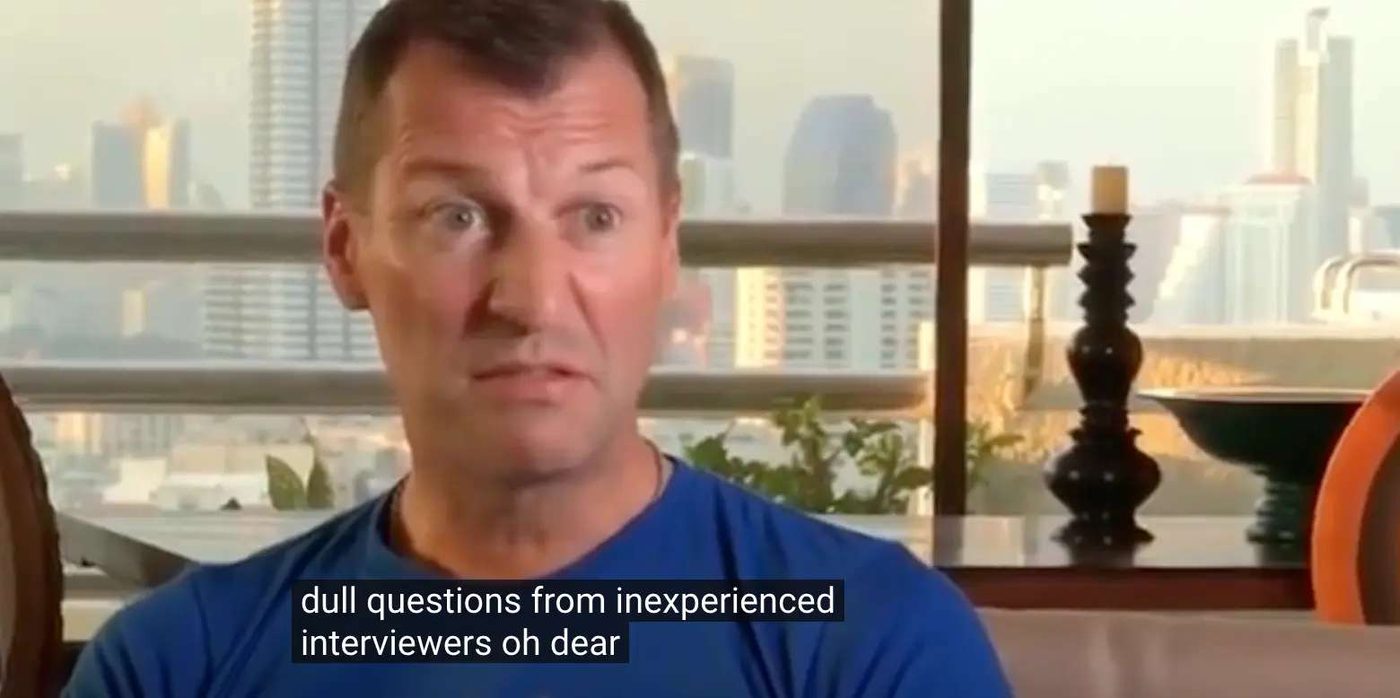
As he was cross-examined, it was good to see him being held to account; yet also galling to sit feet from him and witness him say what we both knew were repeated and shameless lies intended to significantly damage someone who was in fact the real victim.
However, the trial seemed to be overwhelmingly one-sided and in my favour. Gary did not even show up for the final day of it.
My lawyer was confident, but I had heard that before after the labour court trial.
The verdict would come three months later.
And so, on March 2nd, 2018, I stood before a judge in Bangkok South Criminal court facing a possible 5 years in prison.
I had made no plans if found guilty. Many people had, throughout the year, told me it would be easy for Gary to bribe the judge and that I should pay Gary off. It was all very, very stressful.
Now I was the defendant. A guard stood behind me holding chains that would be applied to my feet and hands if found guilty.
Come the day of the verdict, Gary did not even show up. However, before we entered the court, his lawyer scurried up to my lawyer and said Gary would, at this last minute, drop the case if I gave him 6.4 million baht. We ignored him.
And this time the judgment was in my favour(45).
The judge said Gary had provided no evidence for his claims and that I had had reasons and evidence to believe that what I said in labor court was true. The case was dismissed.
Once the judge had started reading the verdict the guard with the chains had gotten up and left the courtroom. I, on the other hand, was still waiting for the translator to tell me what was being said.
Gary had skipped the judgment and, in the end, it was just me, my lawyer and translator before the judge.
Although he would file an appeal, he lost that too.
However, the whole process took 3 years of my life and lots of money, energy and stress.
COMMENT
I went to the labour court to stand up to a bully, a conman, thief and liar in order to make him accountable. I was depending on the Thai justice system to help me do this. To both me and my lawyers, the labour court judgment simply disregarded substantial evidence and substance and was wrong.
And he told so many clear lies in court his testimony should have been deemed worthless.
I sometimes wondered how he lived with himself. Yet, I also recognized in him someone with many of the traits of a narcissistic personality disorder for whom conscience is obliterated and lies are normalised. People like that should not be in positions of responsibility.
And then his heinous criminal accusation. It was absurd, hypocritical, shameless, vindictive, morally repugnant.
However, I “won” that one. The judge agreed I did not lie in labour court so that means something, right? The labour court ruling made even less sense now.
Yet, on the contrary, my lawyers(48)subsequently told me I could not countersue Gary.
This was because, since he had won the labour case, the criminal court would then give him the “benefit of the doubt” against prosecution in a perjury case for everything he said.
Someone who repeatedly lied in court to try to win a case, who was shown to be lying multiple times, who had no witnesses, who showed no evidence to prove he had hired me as a freelancer but quite the opposite, who had been contradicted by my evidence and witnesses again and again in two courts, he can be given the benefit of the doubt for all his lies because…he won a case he lied in order to win?
The man who wilfully tried to represent employment to me and then misrepresent it in court, stole from me, lied through two courts, defamed me in print and to my employer repeatedly, habitually victim blamed, lied about being out of the country for the first inquiry hearing, does not pay taxes, has a nominee shareholdership, bribed the revenue department to escape a tax audit, forced the ex-office manager to sign false testimony, tried to have my ex-colleague lie for him about doing my work, claimed the work I did was done by him, tried to intimidate my witness, has exploited various others in two countries, and then launched a dishonest and malicious perjury case trying to put me in prison….
Him? He gets the benefit of the doubt?
This legal system was an ass.
He had a pattern and practice of proven lies, and a strategy of repeated exploitation of his employees, victim blaming, claiming their work as his, and attempting to “negotiate” a quick settlement in his favour in order to appropriate their money.
This account has been a small attempt to redress the balance. Some kind of catharsis and justice not afforded to me so far. To at least expose a crook outside the confines of the Thai legal system.
It was a trying ordeal to be exploited by him and then to try to pursue justice; to defend myself in a foreign land; in a foreign language; largely alone. It has taken a toll.
I did not “win” in the criminal court; I just did not lose. Justice is still very far away.
He is a criminal. A toxic person. An utter fraud.
He belongs in prison.
Gary Woollacott: A Bangkok Cunt.
Paragraph Where writers share, grow, and get paid - one post at a time.

https://drive.proton.me/urls/XHN5608PXW#s1AdBOZfI77E
Banner image credit: Michael Schulz